What is AI Orchestration? Meaning, Examples, and Why It Matters in 2026

TL;DR
- AI orchestration is the coordination and management of multiple AI agents, models, and tools within a unified system, covering task routing, context sharing, sequencing, error handling, and governance.
- Without orchestration, enterprises running multiple AI systems end up with disconnected tools that create more problems than they solve.
- This guide covers the meaning, how it works, how it differs from agents and automation, the top AI orchestration platforms and tools, real enterprise use cases with named clients, and a practical implementation roadmap.
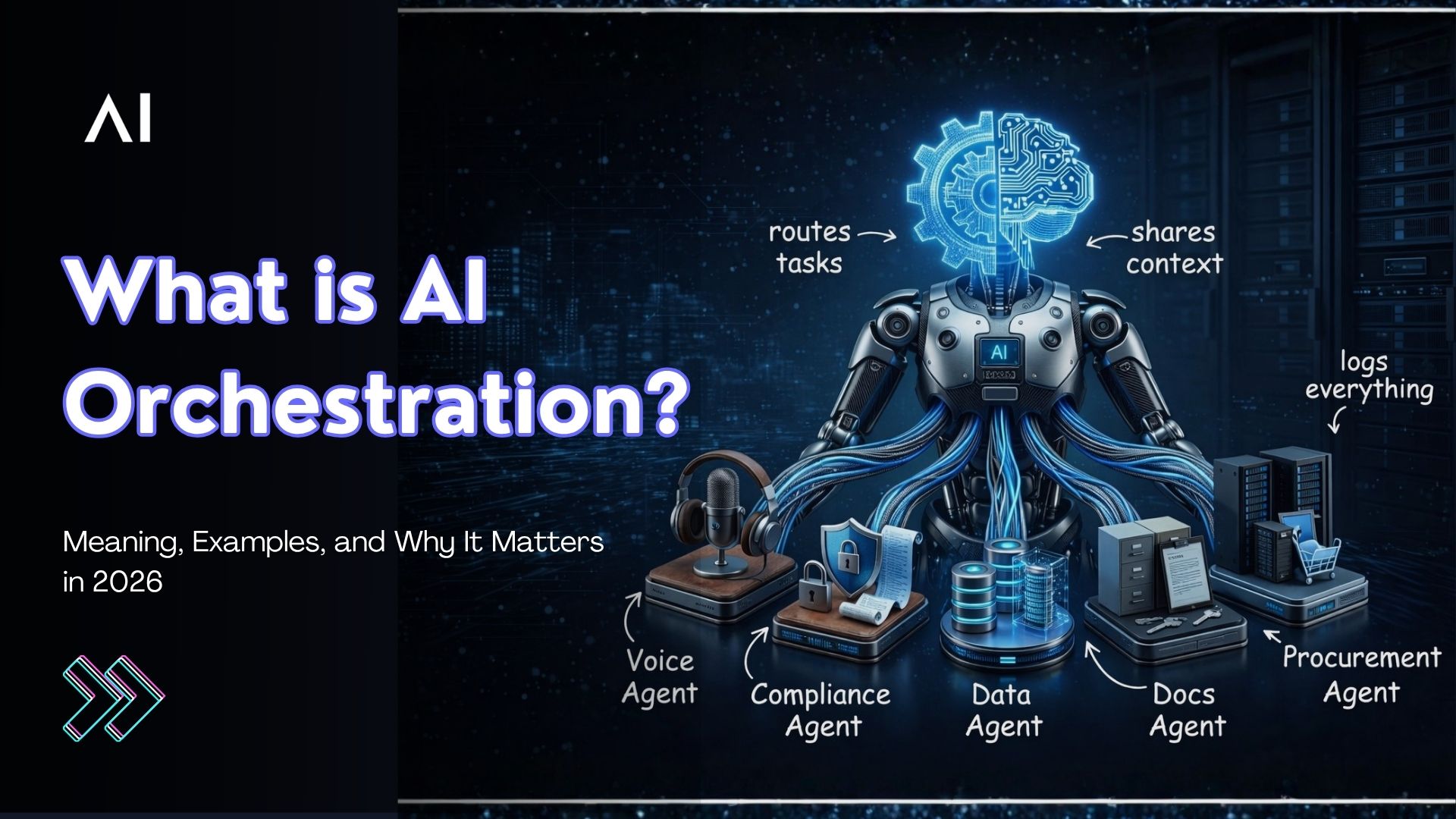
Most enterprises didn't plan to run dozens of AI systems. It happened gradually. A chatbot for customer support. An AI model for fraud detection. Another for document processing. A generative AI tool for content. An analytics model for forecasting.
Individually, each one works. Together, they create a mess.
This is the problem AI orchestration solves.
This guide breaks down what AI orchestration actually is, how it works, what makes it different from automation and agents, and where it's creating real impact in enterprise environments.
AI Orchestration Meaning: A Clear Definition
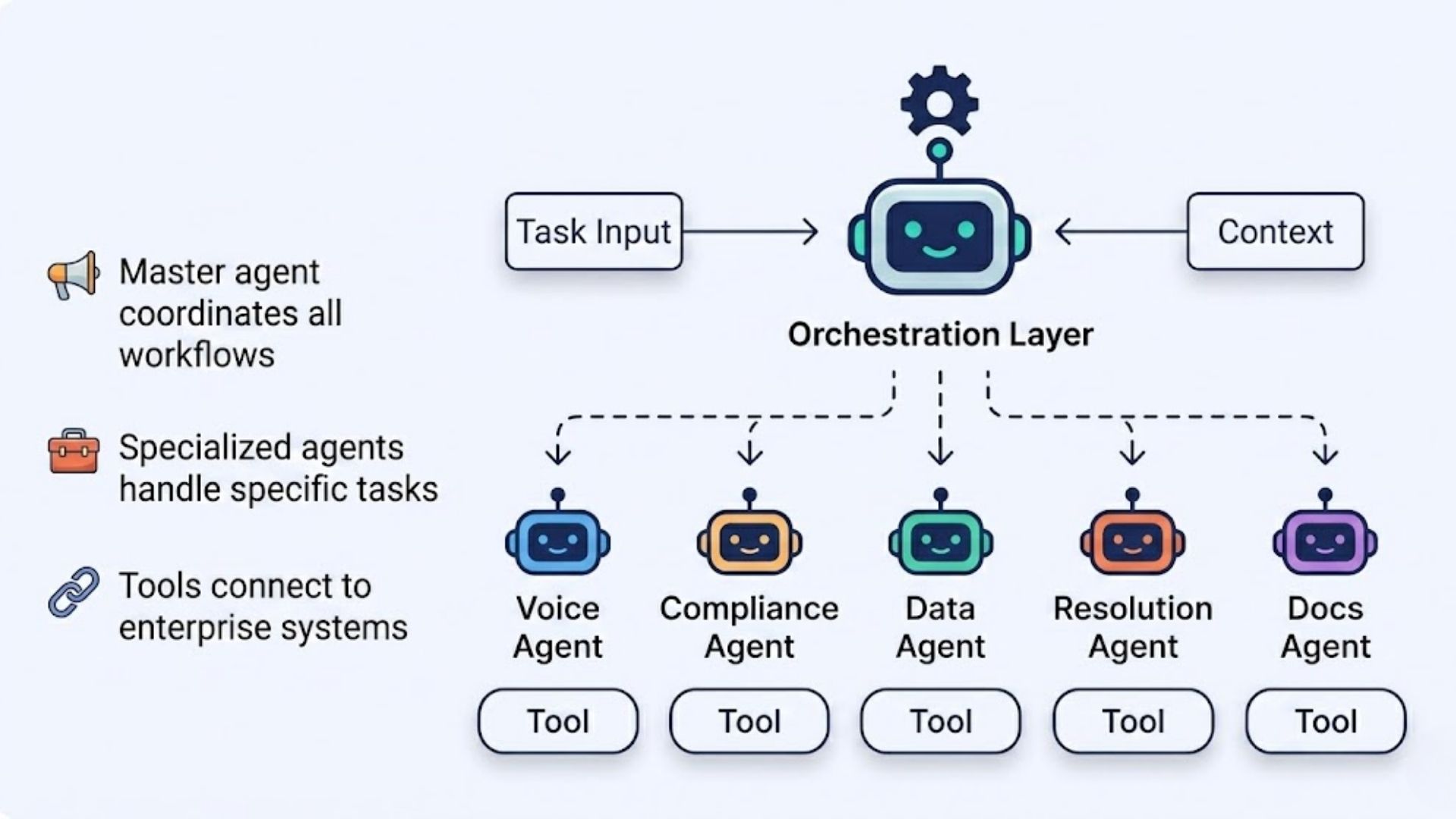
At its core, AI orchestration is the coordination and management of multiple AI models, agents, tools, and data sources within a unified system. It covers the deployment, integration, sequencing, monitoring, and governance of every component in a larger AI workflow.
An AI orchestration platform doesn’t replace models or agents; it connects them, routes the right task to the right model with the right data, and passes outputs to the next step.
In practical terms, orchestration manages:
- Task routing: Directing each part of a workflow to the most appropriate agent or model
-
- Context passing: Sharing relevant information between agents so no context is lost at handoffs
- Sequencing: Determining the correct order of operations across multi-step processes
- Error handling: Managing failures gracefully through retries, fallbacks, or escalation
- Governance: Logging every decision for auditability, compliance, and transparency
As generative AI spreads, organizations use LLM orchestration to scale capable apps without collapsing under complexity.
How AI Orchestration Works: The Core Components
1. AI Integration: Connecting the Pieces
Integration is the foundation. Without it, every AI system operates in its own silo.
What it does:
- Connects AI models, databases, APIs, and enterprise systems into one unified data flow
- Builds data pipelines that organize, store, and move data automatically across the organization
- Chains models together so the output of one becomes the input of the next
- Enables real-time communication between agents that need to act simultaneously
Without integration, AI models operate on incomplete or outdated information. The fraud model doesn't know what the customer service agent just discussed. The compliance engine can't see what the data agent retrieved.
Example: In banking, integration connects a voice AI agent with the core banking system, compliance database, CRM, and fraud detection engine. When a customer calls about a suspicious transaction, all four systems talk to each other in real time, not sequentially, not manually.
2. AI Automation: Executing Without Bottlenecks
Once systems are connected, automation handles execution, tasks and decisions happening without a human clicking "approve" at every step.
What it does:
- Dynamically routes tasks to the right agent based on context, not rigid scripts
- Self-manages compute resources, prioritizing memory and processing power where needed most
- Automatically deploys patches, updates, and new models to minimize disruptions
- Detects underperformance and reroutes workflows in real time
Example: An orchestration system can detect that a customer service agent is underperforming on a specific query type, automatically route those queries to a different agent, and log the decision for review, all without human intervention.
3. AI Management: Governance at Scale
Management is where orchestration earns its value in regulated industries. This is the layer that makes AI auditable, compliant, and trustworthy.
What it covers:
- Performance monitoring every agent and model in real time
- Ensuring clean, reliable data flows to every AI component
- Access controls, audit trails, encryption, data protection
- Model lifecycle management, versioning, updates, drift detection, retirement
Example: For enterprises in banking, healthcare, and government, this layer isn't optional. Every AI decision needs to be traceable, explainable, and defensible under regulatory scrutiny.
To understand how individual agents within an orchestrated system plan, remember, and execute their tasks, see: [Inside an AI Agent's Brain: Planning, Memory, Tooling & Execution Layers Explained Simply]
AI Orchestration vs. Agents, Automation, MLOps, and Workflow Orchestration
These terms are often confused. Here's how they actually differ:
| Concept | What It Does | Relationship to Orchestration |
|---|---|---|
| AI Agent | A single autonomous system that plans and executes specific tasks | Orchestration coordinates multiple agents together |
| AI Automation | Completes tasks without human intervention using rules or AI | Orchestration manages how automations connect and sequence |
| MLOps | Manages the lifecycle of individual ML models, including training, deployment, and monitoring | Orchestration integrates ML models into broader business workflows |
| Workflow Orchestration | Ensures tasks happen in the right sequence, often in a rule-based manner | AI orchestration adds intelligent decision-making to workflow sequencing |
| Agentic AI OS | The enterprise operating system powered by coordinated AI agents | Orchestration is the engine that powers the Agentic AI OS |
AI Orchestration in the Real World: Enterprise Use Cases
Every competitor blog uses hypothetical examples. Here's what orchestration actually looks like in production.
1. Banking: Multi-Agent Customer Resolution
A customer calls about a disputed transaction. Five agents coordinate simultaneously:
- Voice agent captures the query and identifies intent
- Compliance agent checks regulatory requirements
- Data agent pulls full transaction history from core banking
- Resolution agent presents options to the customer
- Documentation agent logs every step for audit
The customer experiences one seamless interaction. Behind the scenes, five agents handled what traditionally required three departments and 48 hours.
2. Procurement: End-to-End Purchasing
One request triggers a chain of agents:
- Agent 1 discovers suppliers
- Agent 2 compares quotes (even in completely different formats)
- Agent 3 creates the purchase order
- Agent 4 routes approvals
Real results: Sourcing cycles from weeks to days. Cost savings from 3–5% to 8–15%. Tail spend under management from 30% to 90%.
3. IT Operations: Self-Healing Infrastructure
An alert fires at 3 AM:
- Diagnostic agent analyzes the alert
- Log agent checks recent deployments
- Resolution agent applies a known fix
- Escalation agent notifies humans only if the fix fails
All four coordinate in under 60 seconds. MTTR drops 40–60%. False escalations cut by 50%.
4. Customer Support: Cross-Channel Orchestration
A customer starts on chat, continues on voice, follows up by email.
In an orchestrated system, context flows across all three. The voice agent knows what the chatbot discussed. The email agent knows what was resolved. No information lost. No repeating.
This is the shift from multichannel (separate systems) to orchestrated omnichannel (one coordinated system).
So the best AI orchestration tools depend entirely on your context. For enterprise production in regulated industries, you need a platform with governance built in. For experimental or developer-led projects, open-source frameworks offer maximum flexibility. For non-technical teams, no-code tools get you started without engineering dependency.
Benefits of AI Orchestration
- Scalability without chaos: Centralized control as you grow from 5 agents to 50+. Adding capabilities = deploying a new agent, not rebuilding infrastructure.
- Cross-system intelligence: Fraud models, service agents, compliance engines working together. Compound intelligence no single model achieves alone.
- Governance at scale: Every action logged. Every decision traceable. Every escalation documented. Non-negotiable in regulated industries.
- Reduced duplication: One shared AI infrastructure instead of overlapping tools across departments that don't talk to each other.
- Faster time to value: Agent templates and pre-built integrations. Days to deploy, not months. Up to 60% higher ROI vs isolated AI tools.
- Team collaboration: One workspace where data scientists, engineers, ops, and business leads all see what every AI component is doing.
Steps to Implement AI Orchestration
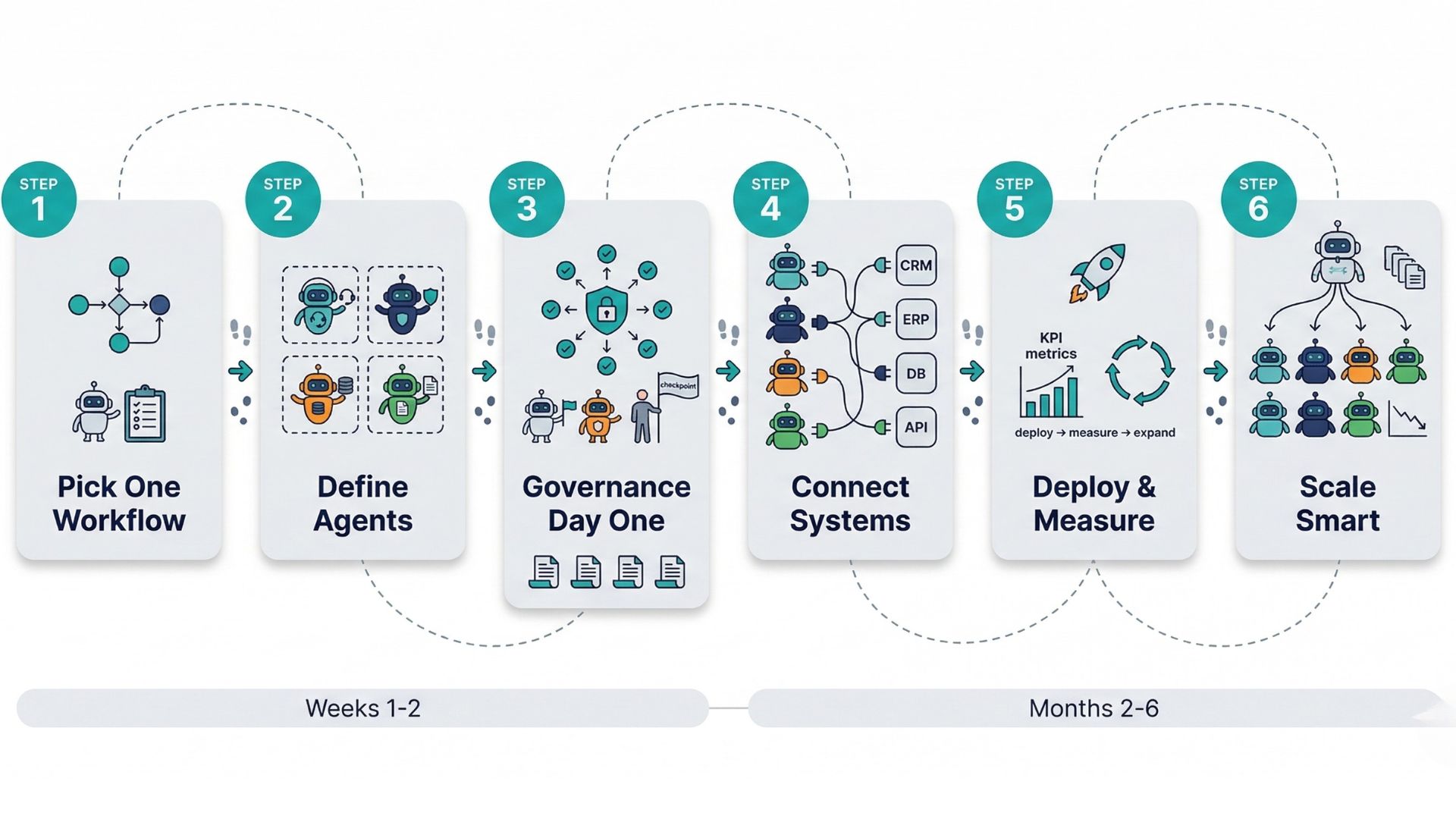
Don't orchestrate everything at once. Phase it.
Step 1: Pick one workflow. Choose something with multiple systems, clear KPIs, and representative complexity. Customer support, procurement, or compliance monitoring.
Step 2: Define agents. Each agent gets a clear role, defined capabilities, and boundaries. Not every agent needs the most powerful model.
Step 3: Governance from day one. Logging, audit trails, access controls, human-in-the-loop checkpoints. Before the first agent goes live. Retrofitting is 10x harder.
Step 4: Connect systems. Data pipelines, APIs, enterprise tools. Use a platform with native connectors (Snowflake, SAP, Salesforce) instead of custom integration per connection.
Step 5: Deploy, measure, expand. Pilot → KPI check → adjacent processes. Reuse templates and integrations to accelerate each new deployment.
Step 6: Scale smart. Agent templates for common workflows. Multi-LLM routing matching each task to the cheapest capable model. Each new deployment gets faster and cheaper.
Conclusion: Orchestration Is the Real AI Advantage
AI models are getting smarter every quarter. That's not the bottleneck anymore.
The bottleneck is coordination making dozens of AI agents, models, and tools work together without creating silos, duplicating effort, or losing governance.
That's what AI orchestration solves. Not by replacing your existing AI investments, but by connecting them into a system that's greater than the sum of its parts.
The enterprises seeing real ROI from AI in 2026 share three traits: they started with a specific workflow, they built governance in from day one, and they chose an orchestration layer that scales from the first agent to the fiftieth.
The question isn't whether your enterprise needs AI orchestration. It's whether you'll build it deliberately, or scramble to retrofit it after the complexity catches up.