Banks Still Run on SQL: How Agentic AI Is Rewiring It in 2026

TL;DR
TL;DR
Structured SQL remains the backbone of enterprise data, but it struggles with unstructured data and dynamic decision-making.
Agentic AI introduces multi-agent workflows that automate SQL query generation, validation, and execution — making data access faster and error-free.
Vector embeddings + SQL fusion allow banks to bridge structured and unstructured data, enabling richer, context-aware insights.
Explainability and compliance are enhanced as agents not only execute queries but also justify results in audit-ready language.
Future-proof banking workflows emerge when SQL’s reliability merges with Agentic AI’s flexibility, powering fraud detection, risk modeling, and personalized CX.
2026 priority: Banks adopting SQL + Agentic AI integration will move from static dashboards to autonomous, explainable, and dynamic decision engines.
For decades, SQL has been the “accounting ledger” of banking data—rigid, structured, reliable. Banks trusted it to balance books, run audits, and generate reports regulators could stamp with confidence. But in 2026, banking is no longer a world of static tables and nightly batch processes. It’s a 24/7 ecosystem where fraud, liquidity, compliance, and customer demands evolve by the minute.
And here’s the challenge: SQL is brilliant at storing and querying structured data, but it struggles when data must be contextual, cross-channel, or dynamically retrieved in real time. That’s where Agentic AI workflows step in. Together, they form a new nervous system for banks—where SQL remains the backbone, and AI agents act like intelligent messengers moving context, compliance, and insight across the body.
SQL + Agentic AI Convergence: A New Banking Blueprint
Think of SQL as a well-organized library—rows and columns of books perfectly indexed. But the problem? Customers no longer want to browse shelves. They want Siri-level answers: “Show me all transactions that hint at laundering risks in Singapore subsidiaries, cross-referenced with forex volatility last quarter.”
SQL alone can’t interpret that nuance. But Agentic AI agents can.
Query Generator Agents translate natural language into optimized SQL queries.
Vector Embedding Agents map unstructured inputs—like transaction memos or case notes—into representations that SQL can link with structured records.
Retrieval Agents ensure data is dynamically combined, not siloed.
The result: bankers don’t dig for answers; they get them, explainable and auditable.
Learn how Fluid AI powers Banking & Finance Industry.
Agentic AI as the Data Orchestrator
If SQL is the orchestra pit, then Agentic AI is the conductor with a headset. Instead of one monolithic model, banks now deploy specialized “musicians” (agents) that work in harmony:
Query Generator Agent – converts human requests into precise SQL queries.
Compliance Guard Agent – checks whether results breach confidentiality or regulatory rules before delivery.
Summarizer Agent – condenses query outputs into dashboards, narratives, or regulator-ready templates.
Context Enrichment Agent – pulls in market feeds, ESG data, or external alerts for richer context.
This orchestration means reports don’t just show what happened. They explain why it matters and what action to take.
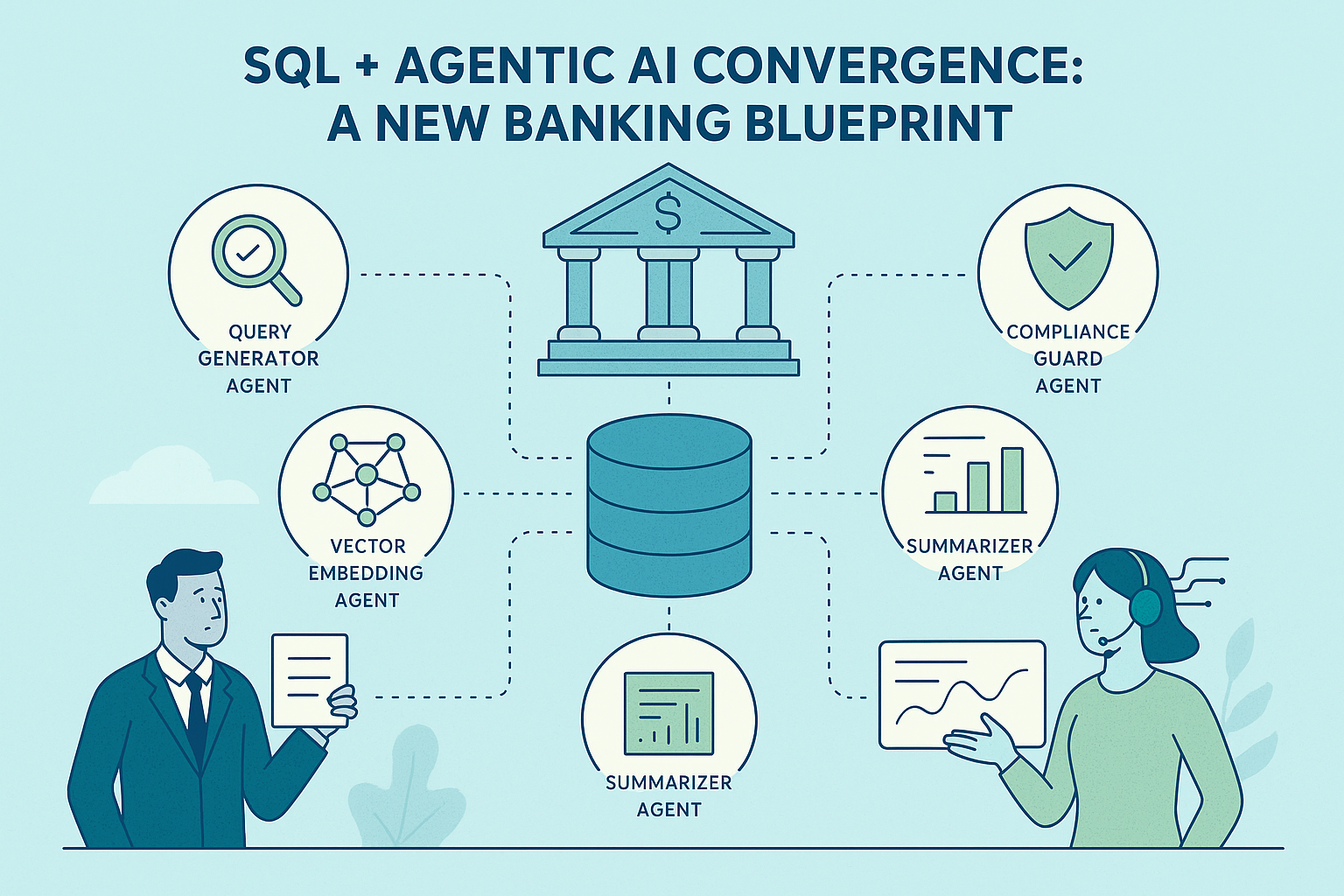
Agentic AI Supercharges SQL in Banking: From Query Generation to Compliance and Summarization
Future-Proofing Data Access in Banking
Why does this hybrid matter? Because banks operate in one of the most regulated, risk-sensitive industries on earth. Pure generative AI pipelines may hallucinate, making them risky. But SQL brings determinism, traceability, and trust.
By layering agentic workflows on top, banks get:
Scalability – handle thousands of queries per day without manual analyst bottlenecks.
Explainability – every agent action is logged, and SQL queries remain traceable for audits.
Flexibility – agents adapt to new regulatory regimes, new product lines, or new data sources.
In short, SQL ensures the foundation never cracks, while Agentic AI makes it flexible enough to bend with the times.
Discover why AI Agents have become a leadership imperative.
Micro-Agents, Macro-Impact: Banking Use Cases That Scale
The real magic lies in small, specialized agents creating massive systemic shifts. Here are 2026’s most powerful banking use cases:
AML & Fraud – Agents monitor SQL transaction tables in real time, flagging anomalies, layering on vector search to catch emerging laundering typologies.
Treasury Insights – Liquidity dashboards generated by SQL queries, enriched by agents that auto-run stress tests against macroeconomic scenarios.
Risk Stress Tests – Agents simulate Basel IV capital requirements across SQL datasets in hours instead of weeks.
Customer Personalization – Agents analyze historical SQL data on spending, cross-reference with lifestyle patterns, and generate hyper-personalized product offers.
Cross-Border Settlements – Agents orchestrate reconciliations across SQL-based ledgers, ensuring compliance with multiple jurisdictions simultaneously.
Each is like a cog in a massive machine. Alone, it seems small. Together, they future-proof an entire banking system.
Read about the 10 Fintech Trends redefining 2026 here.
Agentic AI as the Digital Middle Office
Back-office SQL databases are great at record-keeping. Front-office chatbots are great at conversations. But the middle office—where risk, lending, compliance, and settlements live—has been a gap.
Agentic AI fills that gap. Agents don’t just retrieve data; they orchestrate processes. For example:
A loan officer asks for “all applicants with exposure to declining EV markets.”
SQL retrieves structured records.
A compliance agent screens for red flags.
A risk agent scores the portfolio impact.
A summarizer agent packages results for board review.
The middle office becomes autonomous, not manual.
Boost efficiency with Fluid AI’s Employee Productivity solutions.
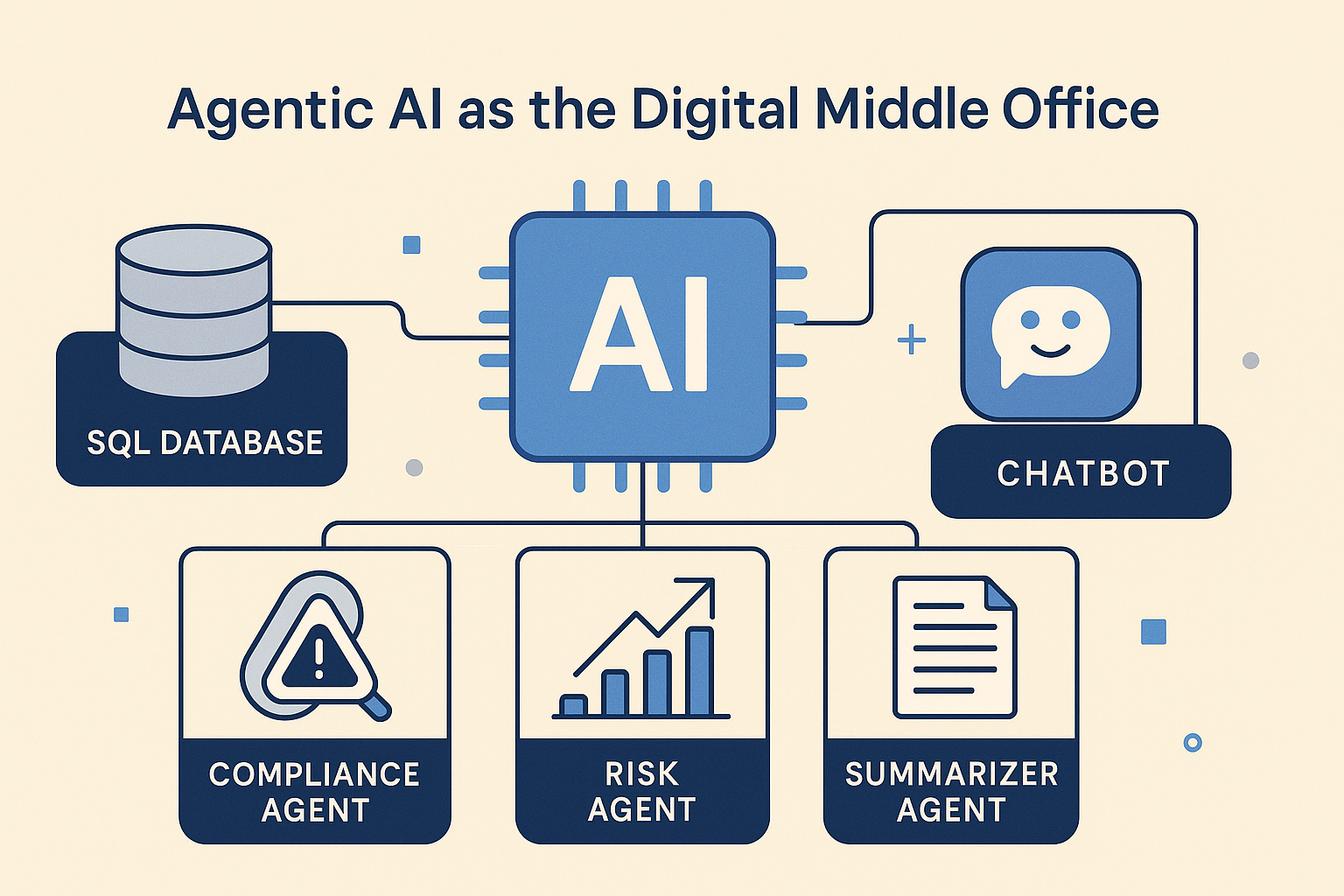
Bridging data and action: How Agentic AI transforms SQL databases and chatbots into proactive middle-office agents.
Regulatory & Auditability: Building Trust in AI-Driven SQL
Global regulators are demanding not just insights but traceable pipelines. Agentic SQL workflows deliver this by logging every step:
Query logs show exactly what data was accessed.
Compliance agents enforce jurisdiction-specific data boundaries.
Summarization agents produce regulator-ready narratives with zero human bias.
Instead of fearing regulators, banks can hand them a transparent trail—like giving an auditor a black box flight recorder.
Technical Layer: SQL Joins Meet Vector Embeddings
SQL engines like Snowflake, Oracle, and Microsoft Fabric are no longer just relational systems. They’re embedding vector search directly into pipelines. This allows:
SQL joins + semantic search in a single query.
Cross-referencing unstructured compliance reports with structured balance sheets.
Query optimization agents that automatically rewrite queries for efficiency.
Think of it like giving SQL a new sense of intuition—not just fetching exact matches, but understanding context like a human analyst would.
How Fluid AI Blends Generative and Agentic Intelligence
Fluid AI’s platform embodies this convergence. By combining SQL reliability with Agentic AI flexibility, it enables banks to transform workflows across the stack.
1. Voice and Digital Assistants
Agents powered by LLMs understand natural language, auto-route calls, clarify intent, and trigger follow-up SQL queries or workflows.
2. Knowledge Assistant
Uses RAG (Retrieval-Augmented Generation) to pull fresh info from internal SQL stores and external market feeds, giving staff consistent, real-time answers.
3. Fluid Answers
Blends conversational AI with action-taking. Customers asking about “last 10 foreign remittance charges” get results directly from SQL while simultaneously triggering refund workflows if anomalies are found.
Built-In Benefits
Multilingual (English, Spanish, and more).
Contextual awareness for precise banking answers.
Real-time SQL + unstructured knowledge integration.
Autonomous routing, escalation, and secure self-service.
Why Banks Need Both
Banks can’t pick between SQL and AI. They need the precision of structured queries and the adaptability of agentic orchestration. Together, they reduce operational cost, enhance compliance, and future-proof customer trust.
Enterprise ROI: Beyond Analyst Hours
140,000 analyst hours saved per year in a top-10 bank by replacing manual SQL query writing.
80% faster compliance reporting using pre-audited, agent-driven SQL logs.
25% cost reduction in treasury operations by automating stress test generation.
It’s not just about speed. It’s about turning data access into a competitive edge, where insight arrives before the risk does.
Explore how enterprises already saved 140,000+ analyst hours with AI agents here.
Closing Thought: SQL Isn’t Legacy—It’s the Launchpad
In 2026, SQL isn’t the dusty ledger of old banking. With Agentic AI, it’s becoming the living nervous system of financial institutions—structured, reliable, explainable, but now flexible and intelligent.
Banks that integrate agentic workflows with SQL won’t just adapt; they’ll lead. They’ll deliver compliance reports regulators applaud, personalized offers customers embrace, and insights boards act on instantly.
The future isn’t SQL versus AI. It’s SQL with Agentic AI. And together, they’re writing the next chapter of banking’s digital transformation.