Agentic OS: Why Every Enterprise Will Run on AI-Native Operating Systems in 2026

TL;DR
AI-native operating systems are becoming the new backbone for enterprise work.
They don’t sit next to your tools — they coordinate them.
Workflows move on their own: ingestion → actions → approvals → escalations.
This is beyond copilots; it’s digital workforces that think and execute.
Early adopters get faster cycles, cleaner context, and an advantage that compounds.

The Shift: From Apps → Platforms → AI-Native Operating Systems
Let’s be honest: enterprises aren’t drowning because they lack software.
They’re drowning because the software they already have refuses to work together.
You have:
CRMs that hold customer history
ERPs that hold transactions
Ticketing systems full of unprioritised noise
Knowledge scattered across SharePoint, Confluence, internal drives
And a patchwork of legacy tools that need constant nudging
So companies keep adding new tools, hoping the chaos will magically settle down.
It never does.
That’s exactly where an agentic OS steps in — as the quiet intelligence that lives above your stack and finally makes it behave like one connected system.
It sees context, detects work, routes tasks, and completes actions.
It’s less “another tool” and more “the execution layer your stack always needed.”
What is an agentic OS?
An agentic OS is an operating system for AI agents: a platform that lets autonomous agents plan, reason, and carry out multi-step tasks across an organization's tools and data, rather than just answering questions. Where a traditional operating system manages hardware and applications for a human user, an agentic OS manages AI agents as the users, giving them a shared layer for memory, orchestration, access to enterprise systems, and guardrails so their actions stay governed and secure.
It coordinates how agents work together, retrieve the right context, call the right APIs, and hand off tasks, turning individual AI models into a connected system that can actually get work done end to end. In an enterprise setting, this is what moves AI from isolated chatbots to a governed environment where agents resolve real workflows across functions like support, IT, and operations.
Not by hand-crafting thousands of integrations, but by using a context layer + reasoning layer + agentic layer that can handle multi-step actions.
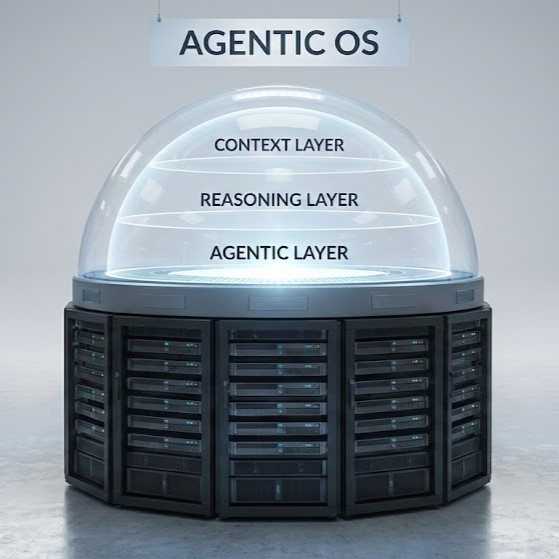
If you want to understand the foundation behind this idea, the closest parallel is the way enterprise systems begin working together through a shared AI layer.
What Makes It “Agentic”
1. Agents that take initiative — not instructions
These aren’t assistants.
They’re doers.
They act when they see signals:
A customer escalates → agent reads context → creates task → routes → follows up
Budget deviation → agent drafts a correction workflow and alerts finance
Contract nearing expiry → agent prepares renewal summary and stakeholder notes
Compliance deviation → agent pulls evidence and starts the sequence
It’s proactive, not reactive.
And it’s the first time enterprise tools have moved without waiting to be told.
2. Multi-LLM intelligence baked into the core
Different work needs different brains.
Small models handle sorting, classification, routing
Mid-tuned models handle policy checks, approvals, compliance
Larger reasoning models handle complex, multi-step operations
This is the same principle behind enterprise multi-LLM architecture — an approach if you want a deeper dive into why “one big model” no longer fits.
3. It orchestrates your tools — it doesn’t replace them
The OS doesn’t want you to migrate off your ERP, CRM, or ticketing tool.
It simply:
reads from them
reasons across them
acts inside them
This is why enterprises adopting agentic architectures start seeing massive coordination gains without touching legacy stacks.
Why Enterprises Need an Agentic OS Now
1. Your tools aren’t broken — your coordination is
Every organisation today has the same quiet bottleneck:
humans acting as glue.
People spend hours copying data, checking fields, following up, drafting replies, routing tickets, validating documents.
The agentic OS handles all of that.
Not faster — instead of you.
2. Your data is rich — but your actions are slow
Dashboards don’t fix problems.
Actions do.
Right now, enterprises collect mountains of signals:
logs
customer journeys
call transcripts
error trails
operational events
policy mismatches
But nothing moves until a human reads it.
An agentic OS turns these signals into immediate workflows, a pattern similar to our breakdown of AI replacing dashboard-based BI.
3. Workloads are rising faster than teams can scale
More customers, more products, more channels, more compliance — but not more people.
A digital workforce built on an agentic OS picks up that load.
It handles volume without sacrificing accuracy.
What an Agentic OS Actually Does (With Real Examples)
These use cases are already live in industries around the world.
1. Customer Support That Fixes Issues, Not Tickets
The OS:
reads the complaint
pulls full customer context
retrieves logs
performs actions (updates, resets, validations)
escalates only genuine edge cases
closes the loop
It mirrors the shift described here, where CX teams move from replies to resolutions.
2. Finance & Approvals That Practically Run Themselves
Procurement, payments, budget checks, reconciliations.
Agents:
check policy
draft approval
send for sign-off
flag deviations
prepare documentation
maintain the audit trail
This is the natural evolution of enterprise-grade agentic workflows.
3. Operations That Detect Problems and Fix Them Automatically
Inventory, logistics, jobs, outages, partner escalations.
Agents:
detect anomalies
match past patterns
execute corrective action
notify stakeholders
update systems
You feel like your operations suddenly learned to self-correct.
4. Compliance & Audit That Run Continuously
Agents monitor:
rule breaches
suspicious patterns
missing data
access violations
irregular events
And prepare reports as things happen — not weeks later.
5. Enterprise Knowledge That’s Actually Searchable
Not hunt-and-guess.
Not ten versions of the same policy.
The OS becomes a living knowledge layer powered by Agentic RAG.
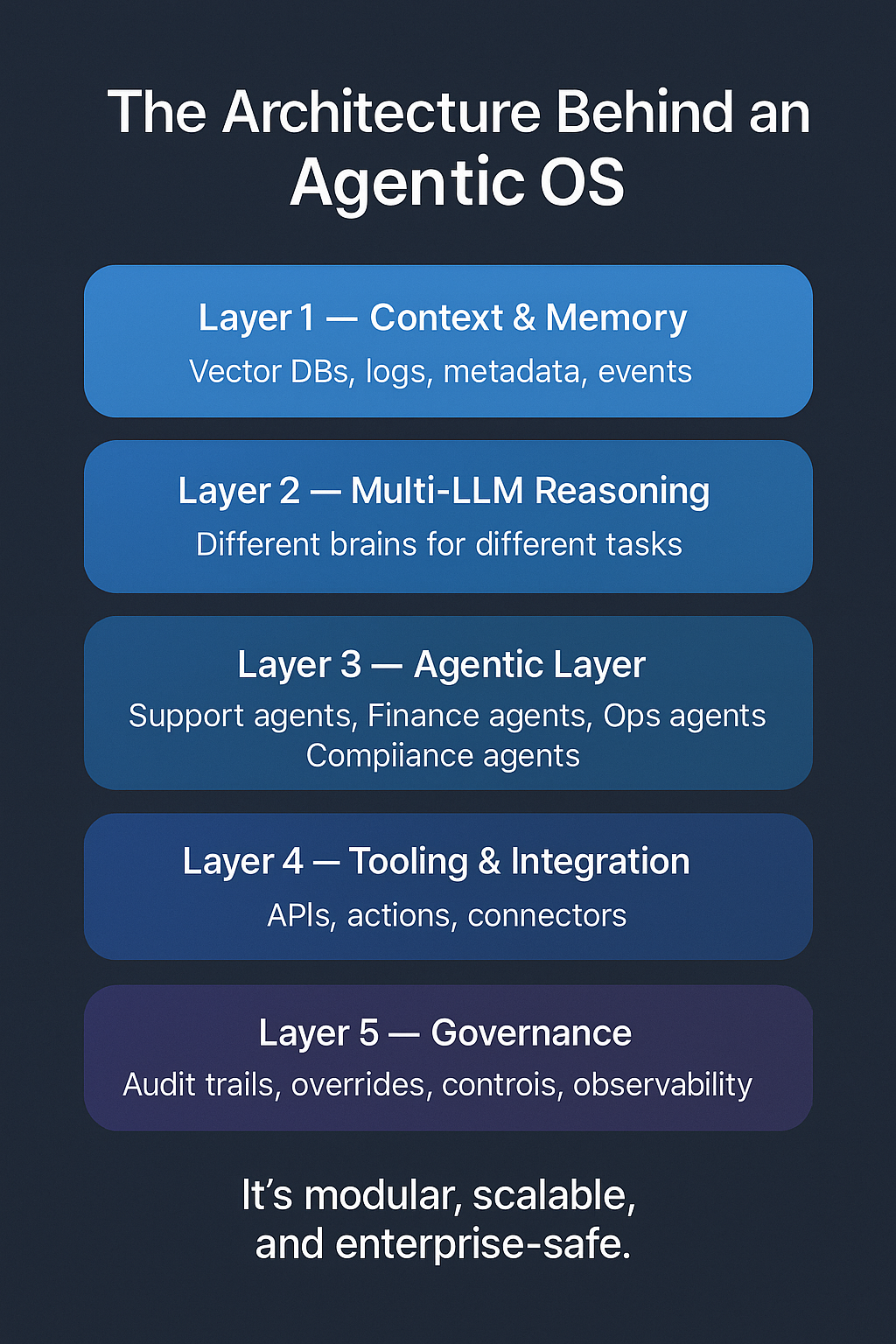
The Architecture Behind an Agentic OS
Why 2026 Is the Breakout Year
Three things are converging:
Interoperability standards — context passing, memory, multi-step reasoning
Faster models — capable of real-time thinking
Operational overload — teams simply can’t keep up
Put them together, and the agentic OS stops being a “future idea” and becomes an inevitability.
How Enterprises Can Start — Without Breaking Everything
1. Pick a single business area
Support, ops, finance, compliance — choose one.
2. Add context-first intelligence
Bring all signals, logs, and metadata together.
3. Deploy one autonomous agent
Solve one workflow end-to-end.
4. Expand into multi-agent teams
Frontline → back-office → orchestration.
5. Layer governance on top
Human checkpoints, audit logs, monitoring.
If you want a clear maturity roadmap, this aligns cleanly with our enterprise agentic AI playbook.
Many organizations also invest in an Agentic AI Workshop to help technology and business teams understand agent orchestration, governance, and enterprise implementation strategies before deploying AI agents at scale.
What This Means for Leadership
If you’re a CIO, COO, CTO, CPO, CHRO — this is the new competitive edge.
The organisations that win the next decade will be:
context-driven
real-time
agent-powered
workflow-native
execution-first
Not “AI enabled.”
AI operated.
An agentic OS isn’t another software line item.
It’s the new foundation everything runs on.
Final Thought
AI didn’t disrupt your apps — it disrupted your operating model.
The moment your enterprise adopts an agentic OS, you unlock a digital workforce that works alongside teams, scales infinitely, and never stops moving work forward.
Frequently Asked Questions (FAQ)
1. What is an agentic OS?
An agentic OS is an AI-native orchestration layer that routes business work to autonomous agents instead of requiring humans to navigate between tools. Think of it as the operating system for enterprise AI - managing agents the way Windows manages applications.
2. Is an agentic OS different from regular enterprise software?
Completely. Traditional enterprise software waits for humans to operate it. An agentic OS runs agents proactively - completing tasks, escalating decisions, and coordinating across systems autonomously. Fluid AI's platform functions as this orchestration layer for BFSI enterprises.
3. Can an agentic OS run on-premise without cloud dependency?
Yes. Fluid AI supports full on-premise deployment of its agentic orchestration layer, running entirely within the enterprise's own data centre. This is the standard deployment model for banks and regulated enterprises with strict data governance requirements.
4. How do enterprises deploy AI agents within their own data centre?
Fluid AI provides a containerised deployment package with agent orchestration infrastructure, enterprise system connectors, and monitoring dashboards. Fluid AI's implementation team manages setup with typical go-live in 8 to 12 weeks.
5. Which enterprises are already running agentic OS in production?
Banks, insurance companies, and large financial institutions are the earliest adopters. Fluid AI's clients in Indian and global banking are already running agentic orchestration layers across customer support, loan processing, and compliance workflows.
Frequently Asked Questions
What is an Agentic OS?
An Agentic OS serves as an execution layer that sits above an enterprise's existing software stack to coordinate systems. It uses a context and reasoning layer to predict what needs attention and deploys agents to complete tasks without constant manual input.
How do agents in an Agentic OS take initiative?
These agents do not wait for instructions but act automatically when they detect specific signals, such as budget deviations or compliance breaches. They can draft workflows, alert stakeholders, and prepare documentation based on real-time data.
Why is an Agentic OS important for enterprises?
Enterprises struggle with fragmented tools where humans must act as the glue to move data between systems. An Agentic OS automates this coordination, allowing the digital workforce to scale volume and handle complex workflows without sacrificing accuracy.