The Death of Tickets: How AI Agents Resolve Customer Issues Without CRM Queues

TL;DR
- Traditional ticket-based customer service is slow, siloed, and outdated
- AI-powered agentic workflows allow for real-time, intelligent issue resolution
- Banking customer support can now operate without CRM queues or human delays
- Agentic AI systems remember context, use enterprise tools, and make decisions
- Eliminates escalations, wait times, and chatbot loops—delivering instant service
- Enterprises see improved customer satisfaction, lower support costs, and better retention
From Backlogs to Breakthroughs: Why Tickets Were Always a Bottleneck
Ticketing systems have long been the default in customer support, especially in banking, fintech, and enterprise services. But they’ve always come with a cost: context loss, delayed resolutions, and frustrated customers. Whether it’s a blocked card or a mortgage query, customers are often forced into a cold queue of CRM tickets, waiting hours—or days—for a response.
This system was born in an era where human agents needed to triage, research, and respond manually. But in a digital-first world, that model feels broken.
Enter Agentic AI.
These are not your typical chatbots. They’re not rule-based systems that answer with pre-defined templates. Agentic AI agents are autonomous, context-aware digital workers that reason, recall, and resolve. And they’re quietly killing off the need for tickets.
What Exactly Is Ticketless Support, and Why Is It Revolutionary?
Ticketless support isn’t just about removing a number from your inbox—it’s a complete rethinking of how customer issues are handled. Instead of filing tickets and waiting, customers interact with an AI agent that:
- Understands the query in real time
- Retrieves relevant context from past conversations and data systems
- Performs actions across enterprise tools (like CRM, core banking, payment platforms)
- Resolves the issue instantly or coordinates multi-agent responses for complex workflows
In essence, it’s like having a human agent with infinite memory, zero fatigue, and real-time system access.
This makes it ideal for high-volume, high-stakes sectors like banking and finance, where users expect 24/7 availability and frictionless resolution.
The Anatomy of an Agentic AI Workflow in Customer Support
Let’s break down what happens behind the scenes when a ticketless, Agentic AI-based support system is in action:
- Input Parsing: An AI agent uses LLMs (like GPT or Claude) to interpret a customer’s natural language query.
- Context Retrieval: The agent pulls semantic memory from a vector database (e.g., Pinecone or Snowflake) to understand past interactions.
- Tool Invocation: The agent accesses APIs from core systems—like loan ledgers, credit card processors, or KYC databases—to gather live data.
- Decision-Making: Using enterprise-defined guardrails, the agent determines whether it can resolve the issue directly or escalate to a specialized agent.
- Action Execution: The agent takes action—resetting a card, confirming a transaction, or scheduling a callback—and confirms resolution with the customer.
This end-to-end loop happens in real time. No handoffs. No queues. No CRM lag.
How Banks Are Already Benefiting From Agentic CX
Forward-looking banks have started embedding ticketless support as part of their digital transformation stack.
Examples include:
- Account Lockouts: AI agents verify identity and reset credentials instantly.
- Transaction Disputes: Agents scan past transactions, flag inconsistencies, and auto-initiate chargeback workflows.
- Loan Status: Customers can query real-time application status with contextual updates from underwriting tools.
- Card Replacement: Agents fetch delivery addresses, confirm KYC, and trigger logistics via backend systems.
The result: support resolutions drop from hours to seconds, and customer NPS scores improve across touchpoints.
Want to see what one AI agent can do on the frontlines of a bank? Explore this real-world transformation: Just One AI Agent Running Your Bank’s Frontline
No CRM, No Problem: The AI Stack Behind Instant Support
Ticketless support doesn’t just remove friction—it reimagines the backend entirely. Here’s the streamlined tech foundation that enables fast, intelligent resolutions without traditional CRM systems:
1. LLMs (Large Language Models)
These are the core reasoning engines. Trained on massive language data, they interpret user intent, ask clarifying questions, and hold multi-turn conversations—delivering a human-like experience, especially valuable in high-trust sectors like banking and finance.
2. Vector Databases
Think of this as long-term memory. Tools like Pinecone or Snowflake Cortex store past interactions and enterprise knowledge in a searchable, semantic format—allowing agents to personalize support based on history and context.
3. Model Context Protocol (MCP)
MCP allows agents to manage complex workflows—invoking tools, referencing past data, and coordinating multistep tasks autonomously. It’s what lets a banking AI agent check your KYC, initiate a refund, and confirm resolution—all in one seamless flow.
A powerful protocol for orchestrating multistep workflows, managing context, and safely invoking tools. Curious how it works? Read: How AI Agents Know When to Call APIs
4. Tool Integration Layer
Via secure APIs, agents plug directly into core systems—CRMs, payment rails, account data, compliance tools. This means they don’t just give answers—they trigger actions.
5. Orchestration & Governance
This layer ensures business logic, security rules, and escalation protocols are followed. Especially critical in regulated sectors, it enables scale without losing control or compliance.
To understand why regulated industries are increasingly leaning toward this model, explore: Why On-Prem Agentic AI Will Rule Regulated Industries in 2025
This modular stack transforms customer service from reactive queues to proactive resolution—delivering on the promise of ticketless, always-on support.
Goodbye Escalations, Hello Autonomous Resolutions
One of the biggest pain points in traditional support systems is the need to escalate tickets. An L1 agent doesn’t have access to systems or decision authority, so every issue becomes a game of pass-the-parcel.
Agentic AI eliminates this entirely.
A single AI agent can:
- Pull up past conversations and history
- Execute secure actions via API
- Make policy-based decisions
- Coordinate with other AI agents for cross-functional support
For example, if a customer has a complaint about a delayed loan disbursement, an AI agent can:
- Pull loan status from the underwriting tool
- Confirm KYC is complete
- Check disbursement queues
- Trigger notifications or human reviews only if needed
This drastically reduces the need for L2 or L3 escalation, saving both time and money.
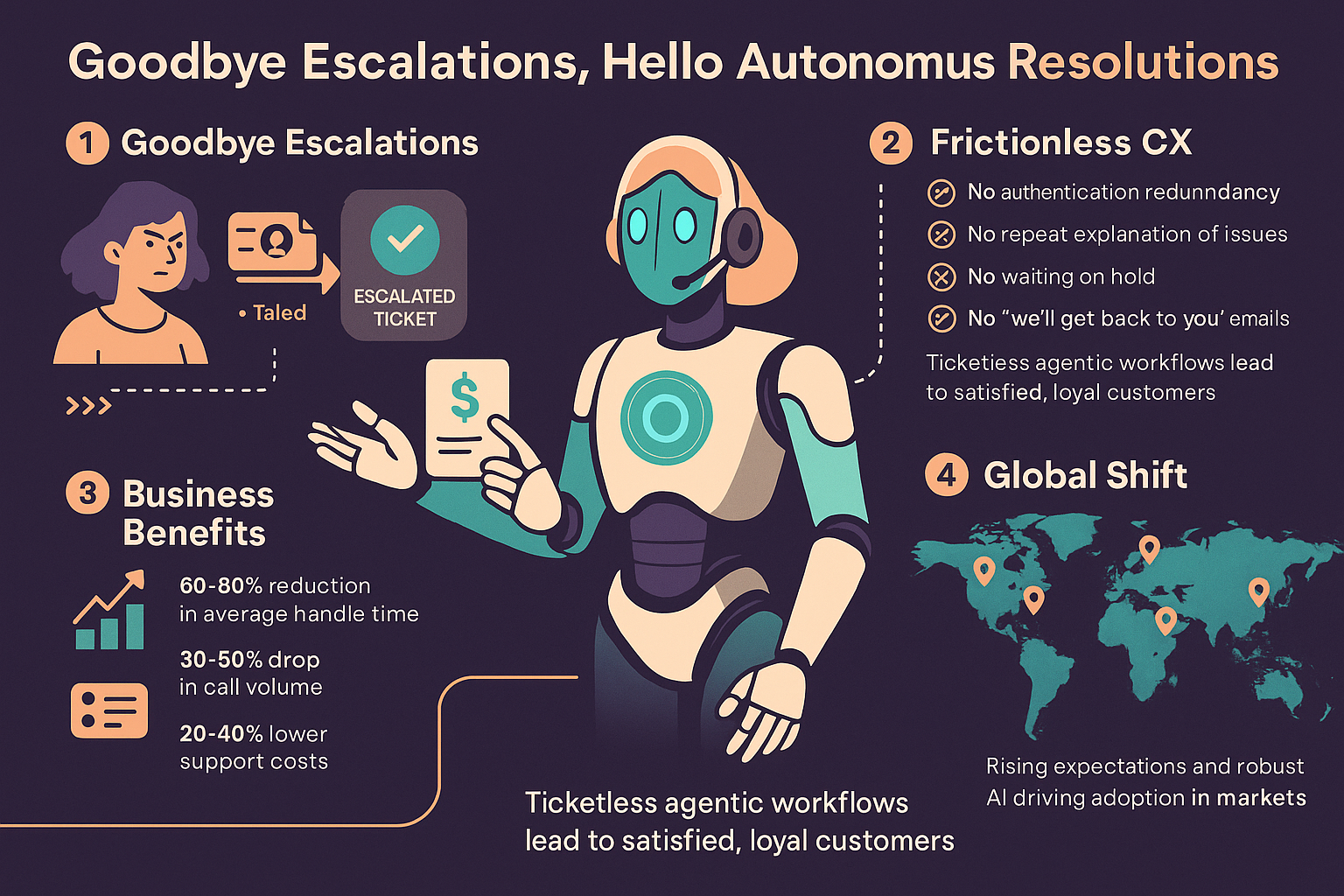
Ticketless CX Also Means Frictionless CX
It’s not just about removing the backend process of ticketing—it’s about removing the experience of waiting, explaining, and re-explaining.
A customer using ticketless support experiences:
- No authentication redundancy
- No repeat explanation of issues
- No shifting between email/chat/app
- No waiting on hold
- No generic “we’ll get back to you” emails
That’s not just operational efficiency. That’s brand loyalty.
In banking especially—where trust and response time are paramount—ticketless agentic workflows are becoming a key CX differentiator.
Business Case: The ROI of Dropping the Ticket
Banks adopting ticketless support are already reporting:
- 60–80% reduction in average handle time (AHT)
- 30–50% drop in call center volumes
- 70%+ CSAT improvement on repeat queries
- 20–40% reduction in support operational cost
Moreover, ticketless workflows unlock true 24/7 availability, serving customers even outside human working hours, with zero compromise in quality.
From a regulatory standpoint, agents also maintain detailed audit trails of every action taken—meaning compliance doesn’t suffer.
Global Trends Driving the Shift to Ticketless Banking CX
This transition isn’t happening in isolation. Several macro shifts are pushing banks and financial institutions toward agentic, ticketless CX:
- Rising Customer Expectations: Instant support has become table stakes
- Chatbot Fatigue: Users are frustrated with rigid, template-bound bot flows
- Generative AI Maturity: LLMs are now robust enough for enterprise-grade support
- Cloud API Ecosystems: Core systems are more accessible than ever
- Cost Pressures: Banks need to optimize support costs without hurting CX
Countries like the US, UK, UAE, and Singapore are leading adoption, particularly in digital-first and neo-banking environments. SEO-optimized terms like AI customer support banking, agentic CX workflows, and ticketless automation are now trending across global finance blogs and tech circles.
To see how data plays a crucial role in making agentic workflows truly effective, read: Snowflake’s Vector DB: The Missing Piece in Agentic AI Workflows
Getting Started: How to Deploy Ticketless Agentic CX
Ready to embrace this shift? Here’s how banks and enterprises should begin:
- Map High-Volume Use Cases: Start with repetitive issues like balance checks, KYC queries, and transaction disputes.
- Choose Your Agentic Platform: Select tools that support memory, tool use, and enterprise integration.
- Build Trust-First Conversations: Train agents to be transparent, auditable, and explainable.
- Iterate with Guardrails: Start narrow (single-agent flows), then scale with multi-agent orchestration.
- Measure Experience Metrics: Beyond speed and volume, track satisfaction, sentiment, and loyalty.
Ditching tickets might just be the smartest support decision you’ll make this decade. Explore Fluid AI’s Customer Support solution to see how leading banks are making the switch.
Final Thought: Ticketing Isn’t Broken—It’s Just Obsolete
Tickets had their time. But in a world where AI can recall, reason, and resolve instantly—why keep the queue?
Agentic workflows mark a shift from support as a process to support as a conversation—live, intelligent, and deeply personalized.
In banking, that means faster resolution, happier customers, and stronger loyalty in a hyper-competitive market.
And for enterprises looking to future-proof their CX? Ditching tickets might just be the smartest support decision you’ll make this decade.