The Rise of Memory-Enabled AI: From Reactive Tools to Reasoning Digital Colleagues

TL;DR
- AI is moving from stateless, reactive models to memory-enabled, reasoning agents.
- Working memory allows AI to remember context, learn from past interactions, and make smarter decisions.
- Persistent AI agents can collaborate with humans, streamline workflows, and boost productivity.
- Ethical and responsible design ensures privacy, transparency, and trust in AI systems.
- Memory-enabled AI transforms from a tool into a proactive, intelligent teammate, amplifying human creativity and strategy.

Today’s AI can perform incredible feats — it can write essays, analyze data, and even generate art — yet it has one major limitation: it forgets everything the moment the interaction ends. But what if AI could remember, reason, and learn from past interactions — essentially, develop a “working memory”? This shift from stateless models to persistent, reasoning AI agents promises to transform the way we interact with technology, turning reactive tools into proactive collaborators that understand context, anticipate needs, and make decisions over time.
When AI Gains Working Memory: The Next Frontier
Today’s AI can do amazing things — write, analyze, create — yet it forgets everything once the interaction ends. Each prompt is treated in isolation, with no memory of what came before. But what if AI could remember, learn, and reason across interactions? This shift toward persistent, reasoning AI agents could turn reactive tools into proactive collaborators that understand context, anticipate needs, and make smarter decisions over time. Check out how agentic AI is already boosting focus, clarity, and ROI.
From Stateless Responses to AI That Remembers
Most AI today operates in a stateless manner: each prompt is processed independently, with no memory of prior interactions. This limits AI to reactive behavior — it can answer questions or generate outputs, but cannot build on past knowledge or adapt over time. Persistent, reasoning AI agents, however, bring a new level of intelligence by retaining context and reasoning across interactions.
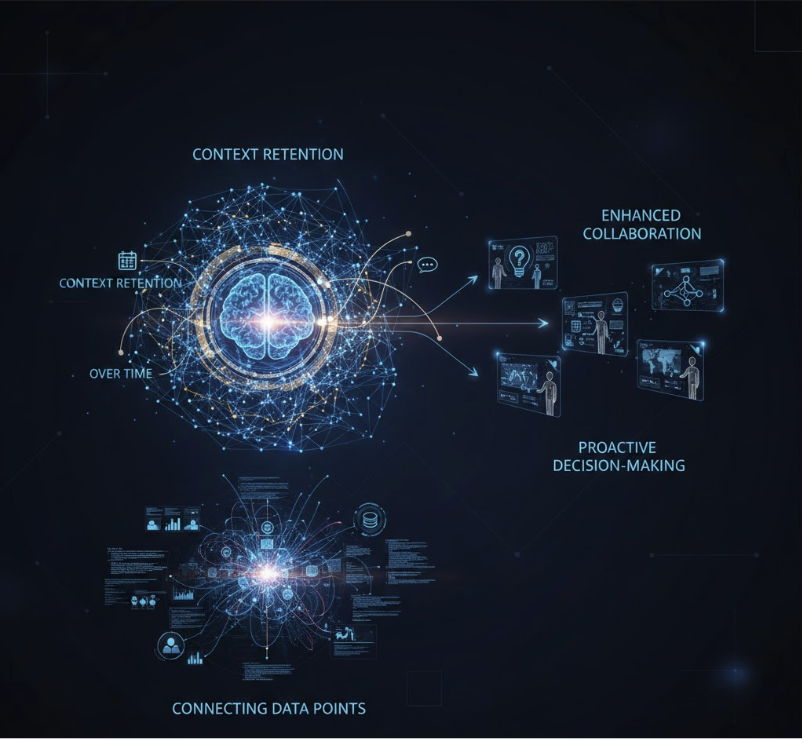
This shift from stateless AI to persistent, reasoning agents represents a major step toward systems that can think, learn, and collaborate in ways that feel far more intelligent — and far more human.
Could AI Think Like a Human?
Working memory in AI serves as a dynamic workspace, enabling systems to retain and process information over short periods. Unlike traditional stateless models, AI with working memory can maintain context, adapt based on prior interactions, and make informed decisions. This capability is pivotal for AI agents to function effectively as digital colleagues, seamlessly integrating into workflows and enhancing productivity. For a closer look at how AI agents are becoming integral team members, learn more in blog on AI agents as digital colleagues.
Capabilities in action:
- Holds relevant information from ongoing tasks.
- Maintains continuity across interactions.
- Uses stored information to make informed decisions.
- Learns from mistakes within a session.
- Supports multi-step processes and planning.
This evolution from static responses to context-aware interactions underscores the transformative potential of AI agents in the workplace.
Enter the Era of Reasoning AI Agents
Persistent, reasoning AI agents take the concept of working memory further by not only retaining context but also planning, prioritizing, and acting autonomously across sessions. Unlike reactive generative models, these agents can track ongoing projects, coordinate with human teams, and make data-driven suggestions. The result is AI that functions as a true collaborator, helping organizations streamline workflows, reduce cognitive load, and make faster, more informed decisions.

Persistent AI agents help teams focus on high-value work, provide continuity across projects, connect insights to drive smarter decisions, anticipate next steps, and act as adaptable digital teammates — all while learning and improving over time.
What Could This Mean for the Future?
As AI develops working memory and persistent reasoning, the implications extend far beyond improved productivity. Organizations can leverage these capabilities to create more seamless workflows, personalized experiences, and smarter decision-making processes. At the same time, this evolution raises critical questions about privacy, data ownership, and ethical use.
How much should AI remember? Who controls this memory? And how do we ensure that these systems act responsibly while collaborating alongside humans?
Business impact:
AI agents streamline workflows and manage multi-step tasks, freeing teams to focus on strategic work. They provide continuity across projects for more efficient operations.
Ethical Considerations:
As AI retains information, privacy, consent, and responsible use become critical. Organizations must decide what AI remembers and who can access it.
Human-AI Collaboration:
Teams will work alongside AI that remembers prior interactions and anticipates needs. This creates a more dynamic and context-aware partnership.
Innovation Opportunities:
Persistent, reasoning AI can unlock new approaches to problem-solving and automation. It enables tools that continuously learn and adapt over time.
The evolution of AI from reactive tools to reasoning agents with memory promises unprecedented opportunities — but also requires careful consideration of how we design, use, and govern these intelligent systems.
Ethical AI as a Strategic Advantage
As AI develops working memory, ethical design becomes a key strength, ensuring that these intelligent agents are not only powerful but also trustworthy. Responsible memory management allows AI to retain only relevant context, respect privacy, and operate transparently, giving users confidence in its recommendations and actions. This focus aligns perfectly with the need for an Enterprise Shield architecture, as discussed in Autonomous AI Agents Become the Enterprise Shield.

By embedding clear rules around what AI can remember and how it uses that information, persistent agents can enforce Zero Trust protocols and act as an always-on, digital immune system. This turns ethical considerations—like controlled memory access—into a competitive advantage for smarter, more reliable collaboration and defense.
So, how can teams work with AI?
Integrating memory-enabled, reasoning AI agents into a team doesn’t replace human expertise — it amplifies it. These agents act as collaborators that can remember project context, track progress across sessions, and provide actionable insights, allowing human teams to focus on creativity, strategy, and decision-making.
- Determine which tasks the AI will manage versus human responsibilities
- Use AI memory to track project milestones, client preferences, and ongoing workflows.
- Treat AI agents as teammates — ask for suggestions, summaries, or predictive insights to inform decisions.
- Periodically assess AI outputs and fine-tune how it supports your team
- Let AI handle repetitive analysis or pattern recognition so humans can focus on innovation and strategy.
By thoughtfully integrating memory-enabled AI agents into workflows, teams can enhance productivity, streamline collaboration, and unlock new levels of creativity — all while maintaining human oversight and control.
Closing Reflections
Memory-enabled AI is transforming from reactive tools into proactive, reasoning collaborators. By remembering context, learning from past interactions, and working alongside humans, these agents boost productivity, streamline workflows, and unlock smarter decision-making. Designed responsibly, AI becomes not just a tool, but a trusted digital teammate — amplifying human creativity and strategy for the future of work.
The future isn’t AI replacing us — it’s AI remembering, reasoning, and collaborating with us to work smarter, not harder.