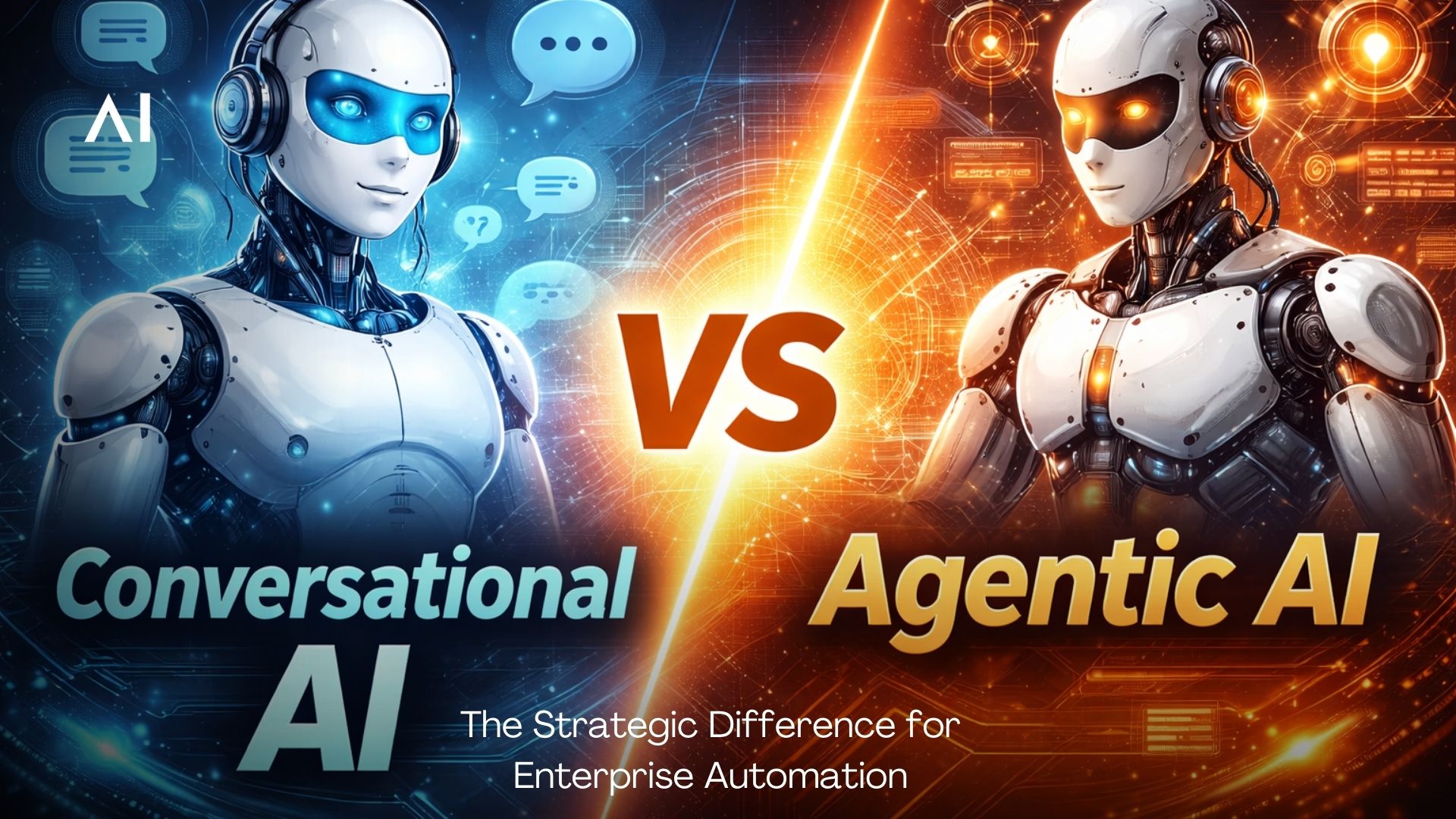
Conversational AI vs Agentic AI: The Strategic Difference for Enterprise Automation

TL;DR
Conversational AI focuses on interacting with users in natural language. It answers questions and guides users through predefined flows. Agentic AI goes beyond interaction. It plans, reasons, and executes tasks across systems, delivering real business outcomes. Enterprises that combine these two effectively can automate end to end workflows, not just automate dialog.
Introduction
Artificial intelligence in the enterprise has grown rapidly. Early adoption focused on chatbots and voice assistants that can interact with people using natural language. These systems help answer questions and reduce support workload. However, many enterprises now want AI to do more. They want AI that can take action, handle multi‑step tasks, and improve operational efficiency. This is where agentic AI becomes relevant.
Conversational AI and agentic AI are related but different. Understanding the difference helps leaders make better strategic decisions about automation and digital transformation.
What Conversational AI Is
Conversational AI refers to technologies that allow machines to understand human language and respond in ways that feel natural. These systems use language models and pattern recognition to interpret text or voice input. Their main role is to engage with users.
Key Functions
- Interpret user questions or requests
- Generate responses in human language
- Maintain conversational context
Where Conversational AI Shows Value
- Customer support chatbots
- Voice assistants for self service
- Basic employee help desks
- FAQ and navigation guidance
Conversational AI excels at answering questions and helping users find information. It can reduce workload for support teams and improve user satisfaction by offering immediate responses.
Years ago, conversational AI helped automate basic support functions in enterprises. Today, many organizations still use these systems for foundational automation.
What Agentic AI Is
Agentic AI refers to systems that can not only converse with users but also execute operations autonomously. These systems combine conversational capabilities with reasoning, planning, and task execution to complete complex workflows.
Agentic AI uses context gathering, goal setting, and automated action sequences to produce outcomes that traditional conversational systems cannot.
Key Functions
- Understand goals across multiple steps
- Plan actions based on context
- Call APIs and integrate with business systems
- Execute automated workflows
Where Agentic AI Shows Value
- Processing refunds or claims in insurance
- Updating customer details in multiple systems
- Performing automated compliance checks
- Completing multi‑step operational workflows
Agentic AI moves beyond simple responses and enters the realm of autonomous action. In practice, this leads to faster operations, fewer manual handoffs, and measurable productivity improvements.
Direct Comparison
| Category | Conversational AI | Agentic AI |
|---|---|---|
| Purpose | Respond to user requests | Deliver completed tasks and outcomes |
| Core Strength | Natural language understanding | Reasoning and autonomous execution |
| Integration | Interface layer only | Deep systems integration |
| Example Task | Answer question about order status | Initiate refund, update records, notify user |
| Typical Use | Chat and voice support | Automated workflows and tasks |
This comparison shows that conversational AI is focused on communication. Agentic AI is focused on action.
How They Work Together
Conversational AI and agentic AI are not mutually exclusive. They can work together.
In many enterprise designs:
- Conversational AI collects user input and intent
- Agentic AI plans and executes tasks based on that intent
- Conversational AI then reports results back to the user
This synergy delivers the best of both worlds — natural interaction and real operational output.
Enterprise Automation Use Cases
Customer Support
- Conversational AI answers status questions
- Agentic AI extracts case details, updates backend systems, and initiates follow‑up actions
Finance and Banking
- Conversational AI helps users inquire about balances or transactions
- Agentic AI automatically resolves exceptions, updates ledger entries, and triggers regulatory reports
Human Resources
- Conversational AI answers policy questions
- Agentic AI initiates onboarding steps, updates systems of record, or schedules training
These examples show how combining both types of AI serves both user experience and operational efficiency.
Strategic Implications for Leaders
Focus on Business Outcomes
Leaders should define what outcomes they want to achieve. Conversational AI improves engagement. Agentic AI improves operations. Defining business goals first prevents investment in automation that does not deliver measurable results.
Plan Integration Early
Agentic AI requires access to backend systems. Early design should include API integration, data flow mapping, and security planning.
Measure What Matters
Conversational systems are typically evaluated using satisfaction or resolution time. Agentic AI should be measured in terms of task completion rate, processing time savings, and cross‑system accuracy.
For deeper thinking on how to structure these systems in enterprise environments, see the strategic guide on integrating systems with agentic AI.
Why This Shift Is Happening
Conversational AI served its purpose when engagement was the priority. Today, enterprises demand actionable intelligence that can complete work automatically. Agentic AI responds to this demand by connecting reasoning, workflow orchestration, and autonomous action.
This trend reflects the increasingly complex automation needs of modern businesses and aligns with how enterprise automation has evolved in recent years.
For more on how enterprise systems can be observed and measured as they scale AI operations, see the piece on enterprise AI observability in 2026.
Conclusion
Conversational AI and agentic AI are powerful tools for enterprise automation. Conversational AI makes systems easier to interact with. Agentic AI unlocks actual work automation by planning and executing tasks without continuous human control.
Enterprises that understand the strategic difference can design automation systems that are not just helpful, but also effective and outcome driven.
If your organization uses conversational AI and wants to scale to full automation, your next step is to explore agentic capabilities that integrate planning and execution with interaction.