From 30 Days to 3 Minutes: How AI Is Automating Insurance Claims and Customer Support

TL;DR
TL;DR
AI in insurance is no longer limited to chatbots or backend automation. Modern AI systems are now handling entire workflows, from claim intake to settlement, from customer query to resolution, reducing turnaround times from weeks to hours and fundamentally changing how insurers operate.
This blog explores how AI is transforming insurance claims processing and customer support, what changes in the workflow, and why this shift is redefining speed, efficiency, and customer experience across the industry.
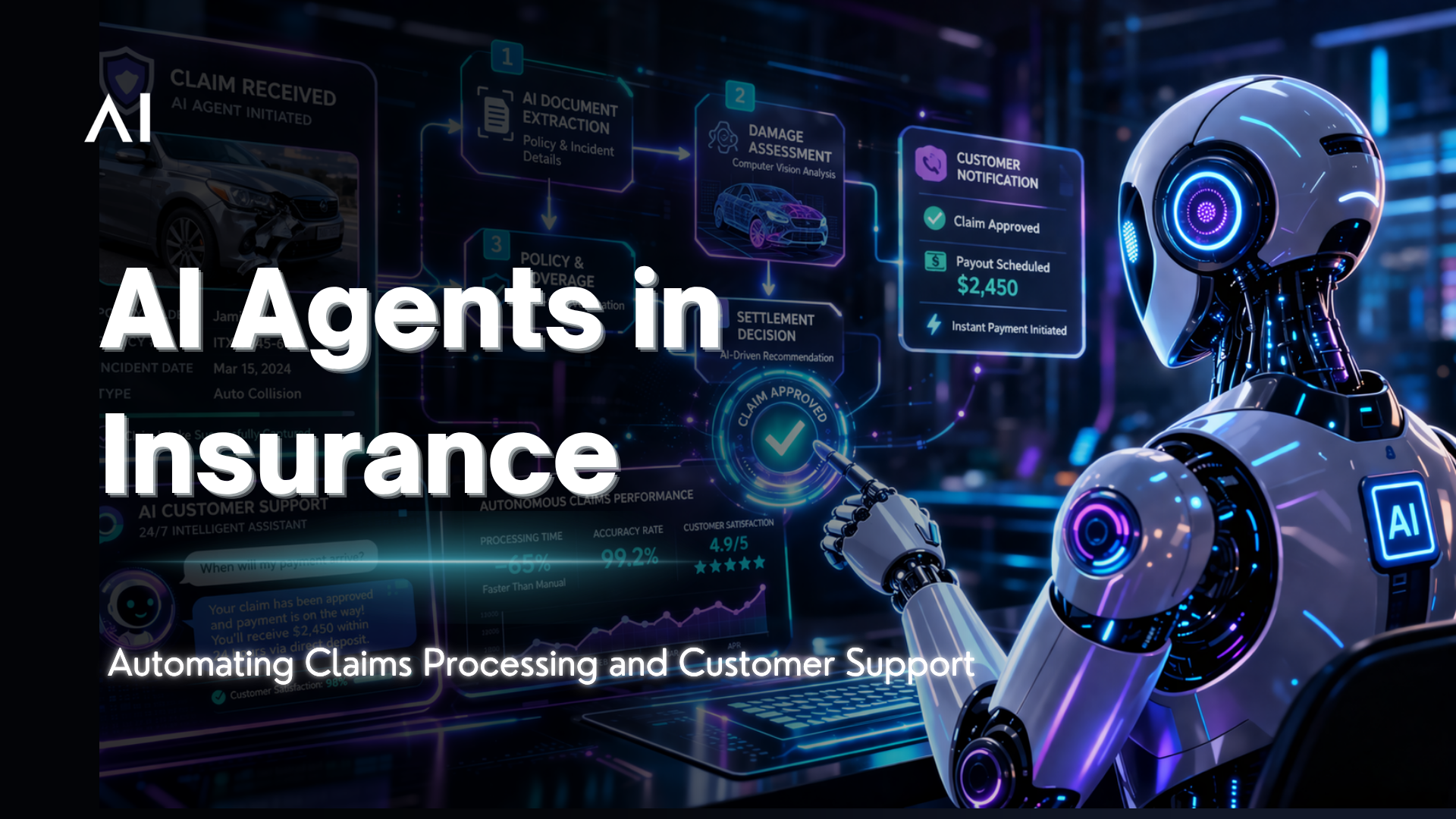
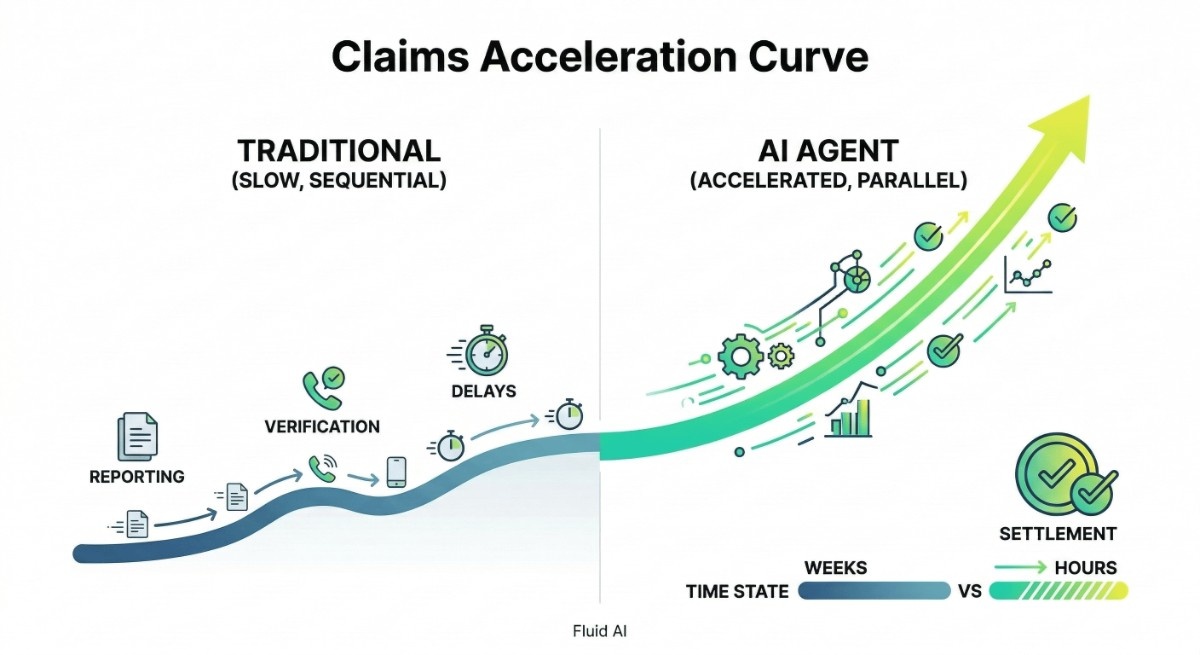
Most insurance claims still take weeks. Not because they're complex. But because they're fragmented.
A single claim moves through multiple steps, reporting, document collection, validation, fraud checks, approvals, and finally settlement. Each step involves different teams, different systems, and often a lot of back-and-forth.
Emails. Calls. Follow-ups. Manual verification.
That's where delays begin.
Now compare that to a system where all of this happens in a single, continuous flow, where the moment a claim is reported, the system already starts validating, checking, and processing it. That shift isn't a future roadmap. Insurers are already processing standard claims end-to-end in under 72 hours. Some, in minutes.
Here's how, and what it actually takes to get there.
What is AI in Insurance?
AI in insurance refers to the use of artificial intelligence to automate, analyze, and execute core insurance processes, from claims handling and customer support to underwriting and fraud detection.
Traditionally, these processes have been heavily manual, involving multiple teams, systems, and back-and-forth communication. AI changes that by introducing systems that can process large volumes of data, identify patterns, and perform tasks that previously required human intervention.
But here’s the shift. It’s no longer just about automating individual steps.
Today, Insurance AI is about systems that can understand requests, make decisions based on context, and take actions across entire workflows. For example, instead of just helping a user file a claim, an AI system can capture the details, verify the policy, assess the claim, and trigger the next steps, all within a single continuous process.
Where is AI used in Insurance?
Here are the real-world AI agent use cases:
1. Claims Processing
Claims are where the impact of AI is most visible.
Instead of relying on manual intake and verification, AI systems can capture claim details directly from chat, voice, or mobile apps, extract relevant information, and validate policies in real time.
They can also analyze uploaded images to assess damage, verify supporting documents automatically, and calculate payouts based on coverage rules.
What used to take multiple teams and days of coordination can now move forward in minutes.
👉 Result: claims that once took weeks can now be processed in hours.
2. Customer Support
Customer support in insurance is largely driven by one thing, claims.
Policyholders want updates, clarification, and next steps.
AI systems handle this differently from traditional chatbots. Instead of responding with scripted answers, they connect to backend systems and provide real-time, context-aware responses.
A customer asking about claim status doesn’t get a generic reply, they get the actual stage, what’s pending, and what happens next.
This transforms support from reactive responses to continuous assistance.
👉 Result: 24/7, real-time support without long wait times.
3. Fraud Detection
Fraud detection is another area where AI adds immediate value.
Instead of relying on static rules, AI systems analyze patterns across claims, detect anomalies, and identify suspicious behavior based on historical data.
This allows insurers to flag high-risk claims early in the process, often before payouts are made.
👉 Result: stronger fraud prevention with higher accuracy.
4. Underwriting Support
AI in Insurance Underwriting involves assessing risk across multiple data points.
AI systems can aggregate data from various sources, analyze risk factors, and generate structured summaries for underwriters.
This doesn’t replace human judgment but significantly speeds up the decision-making process.
👉 Result: faster underwriting cycles with better data visibility.
5. Policy Management and Renewals
Policy servicing is another area where AI improves efficiency.
AI systems can track policy timelines, send reminders, recommend relevant plans, and automate renewal workflows.
This ensures that customers are engaged proactively rather than only at the point of renewal.
👉 Result: improved retention and a smoother customer experience.
How AI Is Transforming Insurance Claims?
Claims processing in insurance is the single biggest operational cost center for most insurers, and it’s also where AI agent in insurance delivers the most immediate, measurable ROI.
Today, AI in insurance claims processing is transforming how insurers handle claims, reducing turnaround time, improving accuracy, and enabling end-to-end automation.
Here’s how AI-powered claims processing in insurance works across the claims lifecycle:
1. First Notice of Loss (FNOL) Intake
Traditionally, FNOL involves phone calls, manual form-filling, and data entry across multiple systems. Top insurance AI agents transform this into a conversational, omnichannel experience.
A policyholder can report a claim via WhatsApp, mobile app, web chat, email, or voice. The AI system extracts all necessary information, policy number, incident details, date, location, and photos, using natural language processing (NLP) and computer vision.
It validates policy status in real time, confirms coverage, and creates the claim record automatically within the core insurance system.
👉 Result: FNOL that used to take 20–30 minutes now takes under 3 minutes.
2. Document Collection and Verification
Claims require supporting documents, repair estimates, medical reports, police FIRs, invoices, and photos. Chasing these documents is one of the biggest bottlenecks in insurance claims management.
AI in insurance automation handles this autonomously.
It identifies required documents based on claim type, sends automated requests to policyholders with clear instructions, verifies submitted documents using intelligent document processing (IDP), flags incomplete or inconsistent submissions, and follows up proactively until the file is complete.
👉 Result: Faster document turnaround with minimal manual follow-ups.
3. Claims Assessment and Adjudication
This is where AI agent for insurance claims processing truly stands apart.
Instead of a human adjuster manually reviewing every claim, the AI system:
- analyzes the claim against policy terms and conditions
- cross-references historical claims data for patterns
- runs damage assessment using submitted images and computer vision
- calculates estimated payout based on coverage limits and deductibles
- routes straightforward claims for auto-adjudication (straight-through processing)
- flags complex or high-value claims for human review with a pre-built summary
👉 Result: Faster decision-making with higher accuracy and consistency.
4. Payment and Settlement
Once a claim is approved, top insurance AI companies triggers the payment process automatically.
The system generates settlement letters, initiates bank transfers, updates the policy administration system, and sends real-time confirmation to the policyholder.
End-to-end, what used to be a 15–45 day claims cycle can now be completed in 24–72 hours for standard claims, with even faster turnaround for simpler cases.
👉 Result: Reduced claim settlement time and improved customer satisfaction.
How AI Is Transforming Customer Support?
If claim processing is the biggest cost center in insurance, customer support is the biggest experience problem.
Most customer queries in insurance are tied to claims, status updates, document requests, policy clarifications, and next steps.
This is where conversational AI for insurance refers to customer support, driving a major shift, from reactive, manual responses to real-time, intelligent assistance.
Here’s how customer support AI in insurance is transforming the experience:
1. From FAQs to Context-Aware Conversations
Traditional insurance chatbots handle a limited set of scripted questions and often fail when queries go beyond predefined flows. AI in insurance customer support changes this completely.
Instead of relying on static responses, AI systems connect to core platforms such as policy administration systems, claims systems, and CRM tools in real time.
When a customer asks, “What’s the status of my claim?”, the system doesn’t return a generic answer. It retrieves the actual claim status, identifies the current stage, explains what’s pending, and provides the next steps.
👉 Result: accurate, personalized responses instead of generic replies.
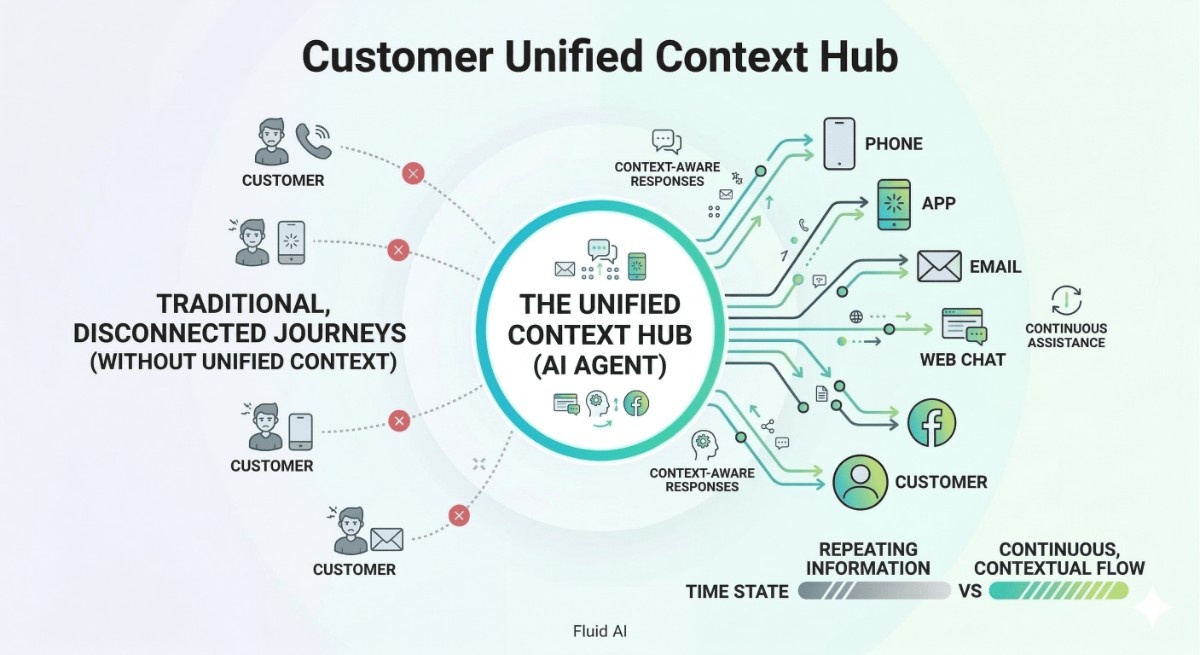
2. Omnichannel Support with Unified Context
Modern policyholders interact across multiple channels, WhatsApp, mobile apps, email, web portals, and voice.
The biggest frustration in traditional insurance customer support is repetition.
Customers are forced to repeat the same information every time they switch channels.
AI in insurance industry eliminates this problem by maintaining a unified customer context across all touchpoints.
A conversation started on one channel can continue seamlessly on another, without losing history or context.
👉 Result: consistent, seamless support across channels.
3. Proactive Customer Communication
Traditional customer support is reactive, customers reach out when they need help.
With AI in insurance automation, support becomes proactive.
AI systems can:
- send real-time claim status updates
- notify customers about pending documents
- alert policyholders about policy renewals
- provide reminders for next steps in the claims process
Instead of waiting for queries, the system keeps the customer informed throughout the journey.
👉 Result: reduced inbound queries and improved customer experience.
4. Faster Resolution with Reduced Workload
A significant portion of insurance support queries are repetitive, claim status, document requirements, policy details.
AI systems handle these queries instantly, without human intervention.
This reduces the workload on support teams and allows human agents to focus on complex or sensitive cases.
👉 Result: faster resolution times and lower operational costs.
5. Seamless Human Handoff
Not every interaction should be automated.
In complex situations, such as claim disputes or sensitive cases, human intervention is required. Customer support AI in insurance ensures smooth escalation.
When a case is handed over, the system provides full context, previous interactions, claim details, and current status, so the human agent can continue without restarting the conversation.
👉 Result: better collaboration between AI systems and human agents.
From 30 Days to 3 Minutes: What Actually Changes
The difference isn’t incremental. It’s structural. Traditional systems operate sequentially, one step after another, each dependent on manual handoffs. AI systems operate in parallel.
Multiple steps including validation, verification, fraud checks, and assessment, happen simultaneously. There are no pauses between steps and no waiting for the next team. This compression of time is what turns:
- weeks into days
- days into hours
- and in some cases, hours into minutes
Not every claim resolves instantly. But even complex workflows move significantly faster because most of the groundwork is already done.
Key Benefits of AI Insurance
Adopting AI agents in insurance operations delivers measurable impact:
- Faster Claims Processing: Reduced turnaround time through automated claims workflows.
- Lower Operational Costs: Less dependency on manual processes and support teams.
- Improved Customer Experience: Instant responses through AI-powered insurance support.
- Higher Accuracy: Reduced human errors in data entry and validation.
- Scalable Operations: Handle thousands of claims and queries simultaneously.
Why This Matters for Insurance Companies
Speed is just the visible outcome, the deeper impact is operational. AI-driven workflows:
- reduce manual errors
- improve consistency
- enable real-time customer communication
- scale without increasing headcount
This is not just efficiency. It’s a shift from human-coordinated work → system-executed workflows.
Conclusion
AI for insurance brokers runs on speed, trust, and accuracy, and AI agents deliver all three at a scale that manual processes simply can't match. Claims that took weeks now settle in hours. Support that frustrated policyholders now builds loyalty. Fraud that slipped through now gets caught before payment.
The insurers moving on AI-powered claims processing and customer support today aren't just saving costs, they're building a competitive edge that compounds with every claim process in insurance and every customer interaction handled. The ones waiting? They'll be playing catch-up.
Ready to Deploy Insurance AI Agents in Your Operations?
Whether you're looking to automate claim process in insurance, transform customer support, or strengthen fraud detection, the right AI partner makes the difference between a pilot that stalls and a deployment that scales.