AI OS vs Cloud vs Agentic AI Agent Platforms: The Difference

TL;DR
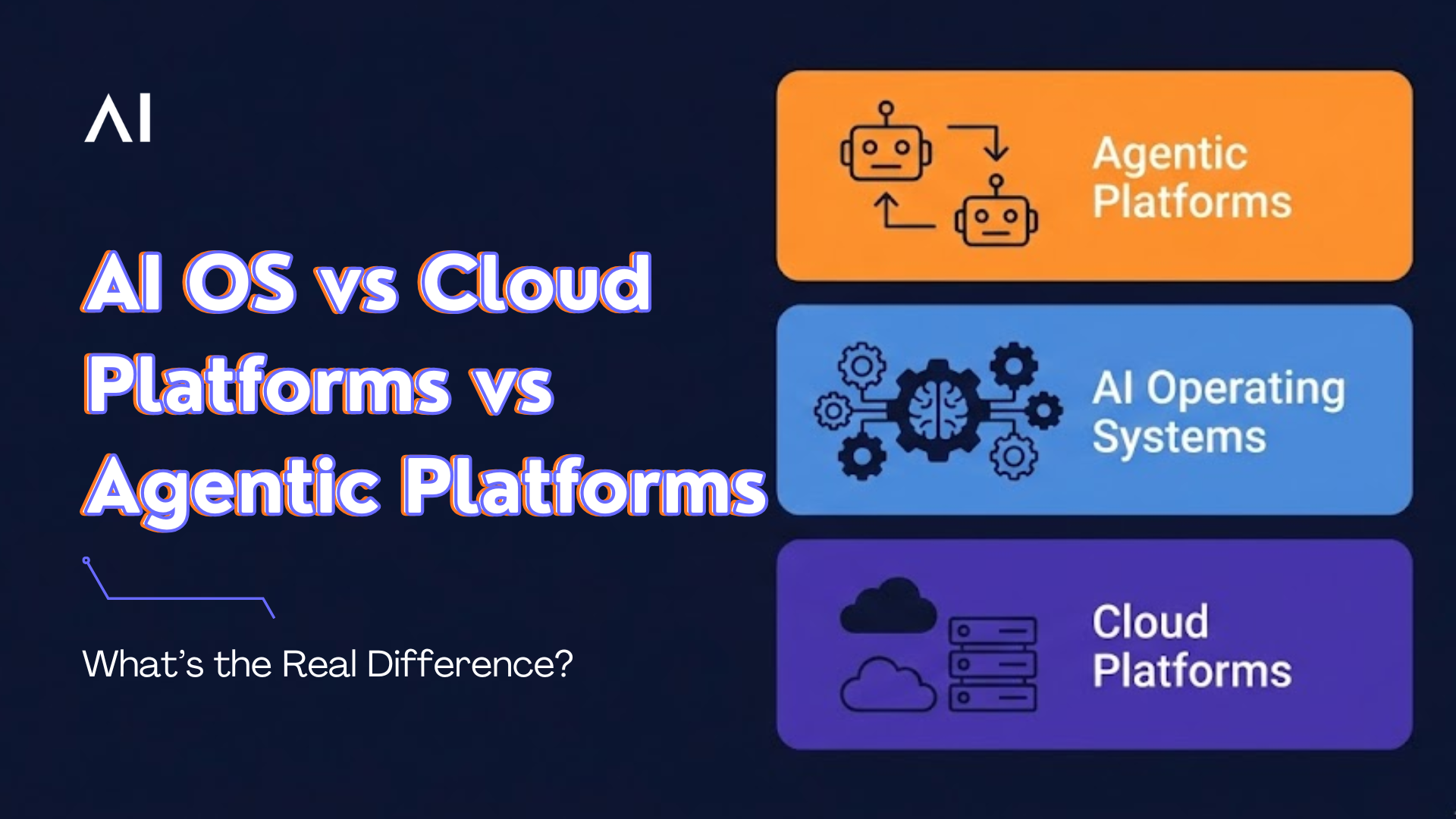
Cloud platforms, AI Operating Systems (AI OS), and AI agent platforms (agentic platforms) execute autonomous multi-step tasks each serve different purposes. Cloud platforms provide infrastructure, AI OS orchestrates intelligent workflows with governance and memory, and Agentic Platforms execute autonomous multi-step tasks. Understanding their differences helps enterprises scale AI efficiently and securely.
Introduction — Why This Comparison Matters Now
As enterprises adopt more sophisticated AI and automation, three terms keep appearing: AI Operating Systems (AI OS), Cloud Platforms, and Agentic Platforms. Each promises transformational value, but they serve very different purposes in your technology stack.
Understanding these differences is critical for executives, architects, and product teams planning enterprise AI deployments — especially if you want to build long‑term, scalable, and autonomous workflows that go beyond traditional infrastructure.
In this blog, we’ll clearly explain:
What each platform does
How they differ architecturally
When you should use one, both, or all in combination
Let’s break it down in plain language.
What Are AI Agent Platforms (Agentic Platforms)?
AI agent platforms, also called agentic platforms, are systems built to execute autonomous, multi-step tasks rather than just host applications or answer questions. Where a cloud platform provides the infrastructure and an AI OS orchestrates workflows with governance and memory, AI agent platforms are the layer where agents actually reason, plan, and act, calling APIs, moving across connected systems, and completing a process end to end with minimal human input.
What Is a Cloud Platform? (The Foundation Layer)
A cloud platform — such as Amazon Web Services (AWS), Microsoft Azure, or Google Cloud — is the infrastructure foundation that enterprises use to host applications, store data, and run services at scale.
Cloud platforms provide:
Compute resources (VMs, containers, serverless functions)
Storage & databases
Networking and security
Managed services (databases, analytics, monitoring)
The cloud gives enterprises the scale, reliability, and flexibility required for modern applications, not just AI. It doesn’t inherently provide intelligence or autonomous behavior — it’s the backbone where workloads run.
When to use cloud platforms:
✔ Hosting scalable infrastructure
✔ Managing enterprise data and services
✔ Running compute-intensive workloads
Cloud platforms are foundational — but they don’t themselves coordinate autonomous AI behavior.
What Is an AI Operating System (AI OS)? (The Coordination Layer)
An AI Operating System (AI OS) is a software layer that sits above the cloud infrastructure and orchestrates intelligent workloads, data, and AI behavior across systems. Think of it like a traditional OS (which manages hardware and resources) — but for AI and intelligent workflows.
An AI OS:
Coordinates tools, models, and data into a unified environment
Manages context and shared memory for agents
Provides communication and scheduling for workflows
Enables governance, security, and scale for enterprise AI
Unlike cloud platforms that host services, an AI OS ensures those services work together intelligently.
When to adopt an AI OS:
✔ You have multiple AI agents that need to share context and execute long processes
✔ You need governance, audit, and security across autonomous workflows
✔ Your business aims to scale AI beyond experimentation into production
What Are Agentic Platforms? (The Execution Layer)
An agentic platform — often called an agentic AI platform — focuses on running AI agents themselves. AI agents are software systems that can act autonomously to achieve goals by interacting with tools, APIs, and environments.
Key characteristics of agentic platforms:
Deploy multiple AI agents for different workflows
Enable real‑world actions (API calls, business process execution)
Provide autonomy and adaptability in tasks spanning systems
Agentic platforms are practical tools where autonomous agents live — such as Inside an AI Agent’s Brain: Planning, Memory, Tooling & Execution Layers.
When to use agentic platforms:
✔ Automating end‑to‑end workflows that require independence
✔ Integrating with multiple systems to complete business tasks
✔ Reducing manual intervention across departments
AI OS vs Cloud vs Agentic Platforms — Side‑by‑Side
Aspect Cloud Platform AI Operating System Agentic Platform Primary Role Provides scalable compute & storage Orchestrates intelligence & workflows Executes autonomous agent tasks Core Value Infrastructure backbone Unified intelligence coordination Task completion & autonomy Scope Broad (all apps) Intelligent layers on top of core infra Focused on autonomous AI agents Example AWS, Azure, GCP Purpose-built AI OS layer Agentic workflow platforms Best For Hosting & scaling services Enterprise AI governance & context Autonomous multi-step tasks
Real‑World Analogy
Let’s use a simple analogy:
Cloud platform is like the land and utilities where buildings are constructed.
AI OS is like a city’s traffic system that coordinates who goes where, ensuring flow and safety.
Agentic platforms are like autonomous vehicles on the roads, driving with purpose based on city rules and context.
In enterprise AI:
Cloud provides infrastructure
AI OS provides coordination and governance
Agents provide action
Common Misconceptions—Clearing Up Confusion
“Agentic Platforms Are the Same as AI OS” — Not Quite
Some confuse agentic platforms with AI OS. While related, they serve different architectural needs:
An agentic platform is where autonomous tasks run
An AI OS manages coordination, memory, context, and governance across agents
“Cloud Platforms Are the Same as AI Platforms” — Also No
Cloud platforms are foundational infrastructure — not inherently intelligent. They host systems, but they don’t coordinate workflows or deliver autonomous decision‑making by default.
When Enterprises Use Each — Use Cases
Cloud Platforms
Hosting databases, applications, computing
Scalable infrastructure and disaster recovery
Broad enterprise service foundation
AI Operating Systems
Managing shared context and memory for AI agents
Coordinating across multiple agentic workflows
Ensuring audit, security, and governance
Agentic Platforms
Running autonomous workflows end‑to‑end
Orchestrating multi-step tasks without human intervention
Triggering actions across systems via APIs and intelligent logic
Conclusion — Choose the Right Layer for the Right Need
Understanding the difference between Cloud Platforms, AI Operating Systems, and Agentic Platforms is essential for future‑ready technology strategy:
Cloud = infrastructure foundation
AI OS = intelligent coordination and governance
Agentic platform = autonomous, multi‑step action execution
Together, they build a powerful trio that enables enterprises to scale AI from experimentation to production.
By aligning these platforms to your business needs — from simple applications to autonomous workflows — you unlock smarter, more efficient, and resilient digital operations.