Effective Context Engineering for AI Agents: The Missing Layer in AI Systems

TL;DR
Context engineering is the practice of controlling the information an AI agent receives during execution. By structuring prompts, memory, retrieved knowledge, and tool outputs within the model’s context window, developers enable AI agents to perform complex tasks reliably.
In this blog, we explore what context engineering in AI actually means, how it differs from approaches like prompt engineering and RAG, the core framework used to build context-aware AI agents, and the best practices that help these systems perform consistently in real-world workflows.
What Is Context Engineering in AI?
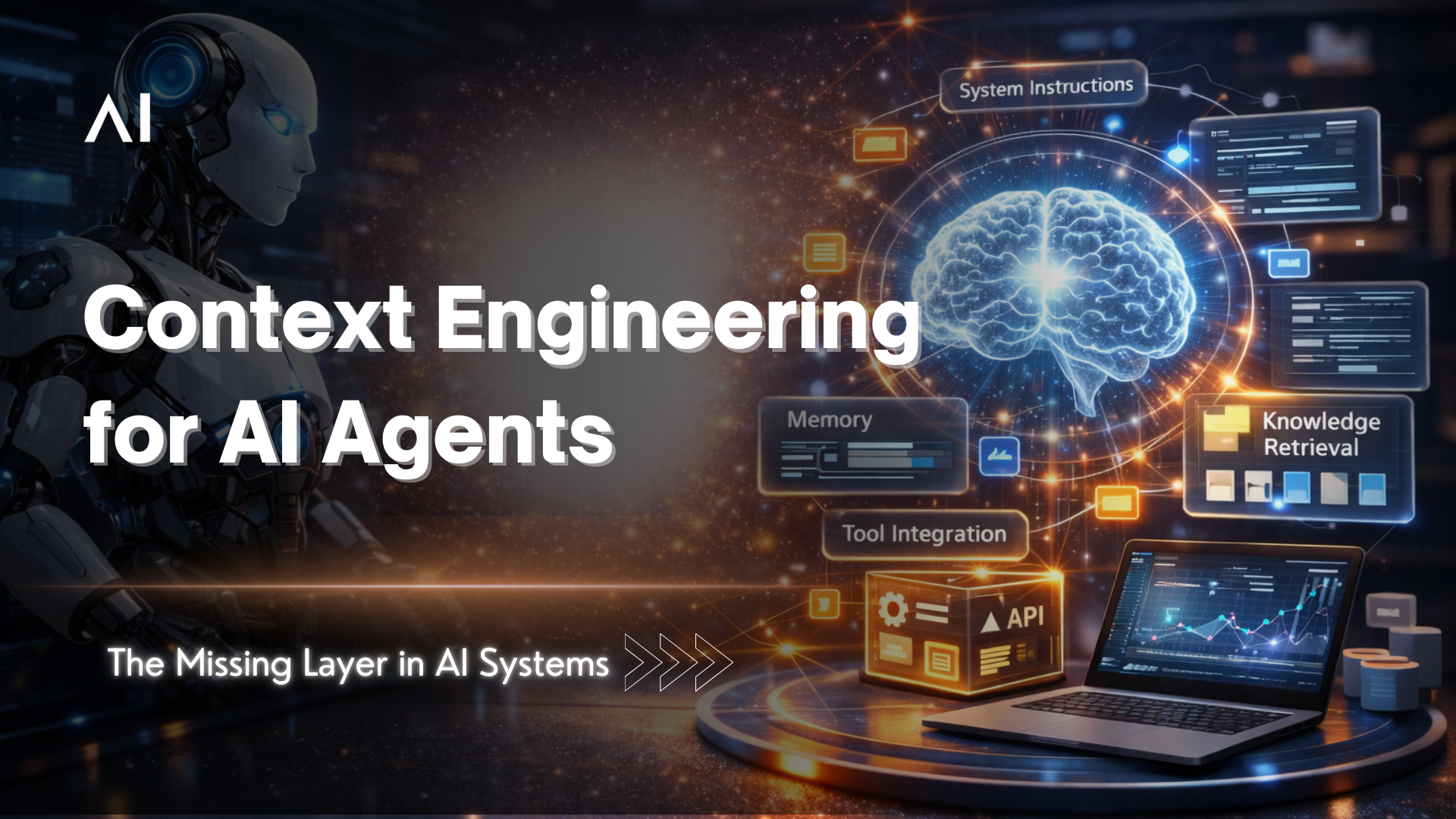
At its simplest, context engineering in AI is the process of designing and managing the information that an AI system receives during execution.
Large language models do not have persistent memory or real understanding of your system. They only see the context window provided with each request.
That context window may contain:
- System instructions
- User queries
- Retrieved knowledge
- Conversation history
- Tool outputs
- Structured data
- Memory records
Context engineering ensures that the right information appears in the context window at the right time.
Instead of a static prompt, the agent receives a curated information environment that evolves during execution.
Think of it like this.
Prompt engineering is writing instructions.
Context engineering is designing the entire workspace where the AI operates. and Without strong context engineering, even powerful models fail.
"Prompt engineering is writing a good sentence. Context engineering is designing the entire library the agent walks into."
Context Engineering vs Prompt Engineering: What's the Difference?
For years, prompt engineering dominated discussions around AI optimization. But as AI systems became more complex, teams realized prompts alone were not enough.
Here’s the difference.
| Prompt Engineering | Context Engineering |
|---|---|
| Focuses on writing better prompts | Focuses on managing the full context environment |
| Static instructions | Dynamic information flow |
| Works well for single interactions | Designed for long workflows |
| Limited to text prompts | Includes memory, tools, retrieval, APIs |
| Short-term improvements | System-level architecture |
Here's a simple way to think about it: if you're writing a better question for your AI, that's prompt engineering. If you're deciding what the AI knows, remembers, and can access when it answers that question, that's context engineering.
Why Effective Context Engineering Matters?
AI agents differ from traditional chatbots in one key way. They perform tasks, not just conversations.
Examples include: handling customer support ticket, analyzing documents, performing research workflows, executing operational processes, interacting with enterprise systems,etc.
For these systems to work reliably, the agent must constantly manage multiple information streams. Effective context engineering allows agents to:
- Maintain working memory: Agents can remember previous steps, user goals, and intermediate results.
- Access external knowledge: Retrieval pipelines pull relevant data from documents, databases, and APIs.
- Use tools intelligently: Agents receive structured outputs from APIs, software tools, or automation workflows.
- Reason across long tasks: Context compaction, summarization, and memory storage prevent the context window from overflowing.
Without these mechanisms, AI agents become inconsistent and unreliable.
The 5-Layer Context Engineering Framework
Most production AI systems follow a similar architecture when implementing context engineering.
A simplified context engineering framework typically includes five layers.
1. System Instructions Layer
This layer defines the agent’s behavior.
It includes:
- role definition
- policies
- task boundaries
- reasoning instructions
- tool usage guidelines
These instructions provide the baseline operating rules for the AI agent.
Example:
You are a customer support AI agent that assists users with banking queries while following compliance guidelines.
This instruction anchors the agent’s behavior across interactions.
2. Knowledge Retrieval Layer
AI agents cannot rely solely on training data. They need real-time access to information.
This layer integrates retrieval pipelines such as:
- vector databases
- document stores
- APIs
- enterprise knowledge bases
Relevant information is dynamically injected into the context window during execution.
This approach is often implemented through retrieval-augmented generation systems.
3. Memory Layer
AI agents must remember what happened earlier in the workflow.
Memory systems typically include:
- short-term conversation history
- structured working memory
- long-term vector memory
Memory enables agents to track goals, previous outputs, and user preferences.
Without memory, every interaction resets the agent’s understanding.
4. Tool Integration Layer
Modern AI agents interact with software systems through tools.
Examples include:
- CRM queries
- database access
- automation scripts
- workflow engines
- analytics dashboards
Tool outputs are injected back into the context window so the AI can reason over the results.
5. Context Optimization Layer
Large context windows still have limits.
Effective context engineering involves techniques such as:
- summarization
- context pruning
- relevance filtering
- memory compaction
These mechanisms ensure the model always receives high-signal information rather than raw data overload.
How the Layers Work Together?
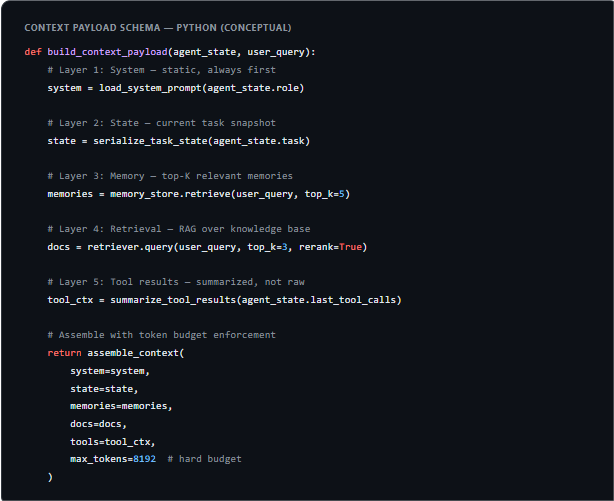
At each agent inference step, a context payload is assembled from contributions across all five layers. The context orchestrator, which can be a dedicated module in your agent framework — decides what to include from each layer, in what order, and at what level of detail. Getting this assembly right is the practical core of context engineering.
Context Engineering vs RAG
Many teams confuse context engineering with retrieval-augmented generation. RAG is only one component of context engineering.
Here’s the difference:
| Context Engineering | RAG |
|---|---|
| System-level architecture | Retrieval technique |
| Includes memory, tools, prompts, workflows | Focuses on document retrieval |
| Manages entire context window | Injects knowledge into context |
| Designed for agents | Designed for knowledge access |
RAG solves knowledge retrieval. Context engineering solves system intelligence.
That’s why high-performance AI agents combine:
- retrieval pipelines
- memory systems
- structured instructions
- tool outputs
- dynamic context management
Context Engineering Examples
Let’s look at real scenarios where context engineering powers AI agents.
Customer Support AI Agents
Customer support AI agents need access to multiple sources of information to resolve user issues accurately. This often includes customer history, product documentation, ticket status, and internal policy guidelines. Through effective context engineering, the system can retrieve the most relevant customer data, combine it with knowledge base articles, and provide responses that are both accurate and aligned with company policies.
Research AI Assistants
Research AI agents typically gather and analyze information from multiple sources while completing a task. Their context may include search results, previously summarized documents, extracted data points, and intermediate reasoning notes. Context engineering helps organize this information so the agent processes it step by step, preventing information overload and enabling more structured reasoning during research workflows.
Enterprise Operations Agents
Enterprise operations AI agents often work across multiple internal systems while supporting business workflows. Their context may include operational metrics, database queries, workflow states, and predefined business rules. With proper context engineering, the agent can combine these data streams, understand the current state of operations, and make informed decisions or recommendations while executing complex organizational processes.
Context Engineering Best Practices
Teams building AI agents are increasingly adopting several context engineering best practices.
- Prioritize relevance over volume: More context does not always improve performance.
Inject only the most relevant information. - Separate system instructions from dynamic data: Keep behavioral instructions stable while allowing the agent to receive changing information through retrieval and memory layers.
- Use structured outputs: Whenever possible, tools and APIs should return structured data such as JSON rather than raw text. This improves reasoning accuracy.
- Implement memory strategies: Short-term memory, working memory, and long-term memory serve different purposes in AI agents. Design these layers deliberately.
- Continuously evaluate context performance: Measure how changes in context affect accuracy, reasoning quality, and task completion.
Context engineering is an iterative process.
The Future of Context Engineering AI Systems
As AI systems evolve, context engineering will become even more critical.
Several trends are already emerging.
- Larger context windows: Models now support hundreds of thousands of tokens, enabling more complex reasoning environments.
- Multi-agent architectures: Systems are increasingly composed of multiple specialized agents that share structured context.
- Autonomous workflows: AI agents are beginning to manage entire workflows without human intervention.
In all these cases, the limiting factor is not the model itself.
It’s how well the context environment is engineered.
Final Thoughts
Effective context engineering for AI agents is quickly becoming one of the most important disciplines in modern AI development.
The shift from prompt engineering to context engineering reflects a deeper understanding of how large language models actually operate.
Organizations that master context engineering will build AI agents that are not just conversational but capable, reliable, and production-ready.
And as AI systems move deeper into enterprise workflows, that distinction will matter more than ever.